The venue took the deposit. The vendors were never paid. The bride paid twice.
Jason Lottman pleaded guilty to wire fraud on July 6, 2026, after running a wedding venue that took full payment for weddings it never intended to deliver. The couples paid vendors twice. Some never walked down the aisle at all.
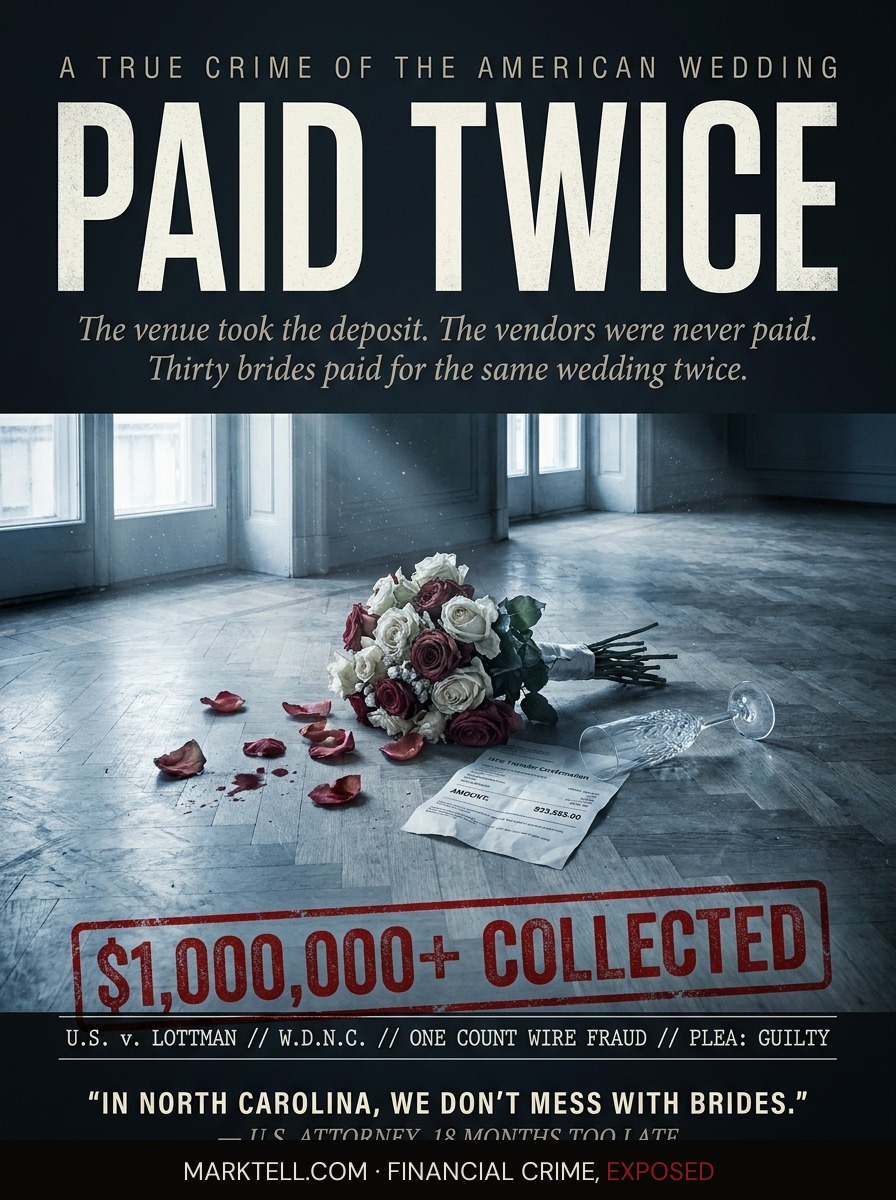
Amber was twenty-nine and she had saved for two years. She was a dental hygienist. She rented a one-bedroom in a complex off Independence Boulevard with a fiancé who worked nights at a distribution warehouse and a cat named Beans. The wedding money sat in a separate account she had opened just for the wedding money, because she had read somewhere that you were supposed to do that.
She wired $33,555 to Champagne Manor on a Tuesday. The wire went out at 2:14 in the afternoon. The confirmation email came back within the hour. She printed it. She put it in a folder marked WEDDING in the drawer of the kitchen desk. She sat at the table for a while after and drank her coffee and let herself feel, for a minute, that the hard part was done.
The hard part was not done. The hard part had not started.
The number is not made up. Amber Wells, a real bride, paid $33,555 to Champagne Manor. Clara Vengoechea paid $30,000. About thirty couples paid something. In total, according to the U.S. Attorney's Office for the Western District of North Carolina, Jason Lottman collected more than $1 million between October 2023 and January 2025.
On July 6, 2026, Lottman pleaded guilty in federal court to one count of wire fraud. He is forty-three. He lives in Charlotte. Wire fraud carries a maximum sentence of twenty years.
The composite is Amber. The pattern is everyone else.
I. THE WRAPPER
There is a specific kind of pitch that works on people who have never bought the thing before. The all-inclusive wrapper. One price. One signature. One man in the middle who says he will handle it.
The wrapper is why the crime works. When you pay a florist directly, you know if the florist got paid. When you pay a venue that promises to pay the florist for you, you find out whether the florist got paid three weeks before the wedding, when the florist calls to ask when you plan to pay your balance.
That is the phone call. That is how a lot of them found out.
Champagne Manor sold packages that ran, according to reporting on the case, between forty and fifty thousand dollars. Catering. Photography. Flowers. DJ. Hair. Makeup. All of it. One number. One contract. One check.
Some couples chose their own vendors. Lottman told them he would reimburse. He did not reimburse.
Some couples used his vendors. Lottman told the vendors he would pay them out of the couples' package payments. He did not pay them.
The couple paid once. The vendor waited. Three weeks out, or two weeks out, or the week of, the vendor called the couple and said, I have not been paid, and I cannot show up unless I get paid.
Then the couple paid twice.
II. THE BALLROOM THAT DID NOT EXIST
While Lottman was selling wedding packages, he was also selling something else. A "Partner Program." Ownership stakes in Champagne Manor. Guaranteed returns. Financial incentives. The kind of language that shows up in every affinity-pitch deck ever printed.
To make the investment feel safe, according to the DOJ release, Lottman told investors that Champagne Manor was in the process of acquiring a glass ballroom. The ballroom, he said, would serve as collateral for the Partner Program.
The ballroom purchase never happened.
Read that slowly. The collateral was fictional. The security backing the investment was a rendering of a room that no one had bought.
This is the second machine running inside the first. The couples were funding a business that had already stopped functioning as a business. The investors were funding a room that did not exist. Both groups were told the money was safe. Both groups were told there were assets behind the promise. Neither statement was true.
III. THE DATE ON THE CALENDAR
Amber's florist called on a Thursday. Three weeks out. Amber was at work. She had a patient in the chair. She stepped into the break room and she listened to the voicemail and she sat down on the plastic chair by the coffee maker and she did not go back to the chair for eleven minutes.
She called the venue. It rang. It rang again. It rang out.
She called the caterer. The caterer had not been paid either.
She called the photographer. Same.
She called the DJ. Same.
She drove home that night and she opened the folder in the kitchen drawer and she took out the wire confirmation and she read the number again. $33,555. It was still there in the email. The money had left her account. It just had not arrived at any of the places it was supposed to go.
The date on the calendar arrived anyway. That is the part that does not go away.
IV. THE FORECLOSURE HE DID NOT MENTION
Champagne Manor defaulted on its mortgage in mid-2024. Foreclosure proceedings began. According to the DOJ, Lottman knew the venue was in severe financial distress and would ultimately cease operations. He kept booking weddings anyway. He kept accepting payments. He kept selling investor stakes.
The last of the payments came in as late as January 2025. Six or seven months after the foreclosure clock started ticking.
Picture that. A man sits across a table from a couple who are planning the biggest day of their lives. He hands them a contract. He tells them the venue will handle the vendors. He takes their check. And the entire time, he knows the building is being taken.
That is not a business failure. A business failure is when the thing you were selling stops working. This is when the thing you are selling has already stopped working and you keep selling it.
V. THE MARKETPLACE
Lottman was arrested, according to reporting, after Union County Sheriff's Office detectives posed as buyers on Facebook Marketplace. He was selling items that had been fraudulently obtained. The detectives set up the buy. He showed up.
Think about the geometry of that. The same man who had run an all-inclusive wedding operation, who had sold Partner Program stakes, who had collected more than a million dollars from about thirty couples, was doing person-to-person Marketplace sales at the end. The wrapper had come off. There was no venue left. There was no ballroom. There was a man selling things out of the trunk of a life that had already collapsed.
U.S. Attorney Russ Ferguson, announcing the plea, said: "In North Carolina, we don't mess with brides." It is a good line. It arrived about eighteen months late for Amber.
VI. THE COST
Amber is a composite. Amber Wells is real, and paid $33,555. Clara Vengoechea is real, and paid $30,000. The dental hygiene job and the cat named Beans are reconstruction. The florist's phone call is reconstruction of a call that, in one form or another, happened about thirty times.
The rest of what I am about to say is not reconstruction. It is what these cases cost.
Some of them still got married. On borrowed money. In backyards. On lawns their aunts owned. With sheet cakes. With Bluetooth speakers instead of DJs. With a friend's cousin who owned a decent camera. The wedding, in some form, happened.
Some of them did not get married that year. They pushed the date. They stopped talking about it for a while. Some of the couples came apart under it. Some did not. I do not know the ratio. Nobody does.
The savings account Amber opened, the one just for the wedding money, is empty. She could open a new one. She probably will not, for a while.
That part may be the saddest.
VII. THE MACHINE UNDER THE WRAPPER
The all-inclusive wedding package is not the crime. Legitimate venues run all-inclusive packages every weekend in this country. The wrapper is not the machine.
The machine is the moment when the wrapper hides the money path. When the couple's check goes into one account and the vendor's invoice goes into a folder no one opens. When the middleman is the only person who knows whether the money got where it was supposed to go, and the middleman has a reason to say yes when the answer is no.
Every all-inclusive package is a small trust exercise. You are handing one person the responsibility to hand your money to a dozen strangers you will never meet. That trust is not stupid. It is how the wedding industry works. It is how a lot of industries work.
The machine is what happens when the person in the middle stops paying and keeps taking.
Jason Lottman pleaded guilty on a Monday. Sentencing has not been scheduled. Wire fraud carries up to twenty years. The couples' money is gone. Where it went is a question the sentencing hearing may or may not answer.
The wire confirmation is still in Amber's drawer. She has not thrown it away.
She wired $33,555 to Champagne Manor on a Tuesday. She thought the hard part was done.
The hard part had not started.
- U.S. Attorney's Office, Western District of North Carolina | July 6, 2026 | DOJ press release announcing Jason Lottman guilty plea to wire fraud
- KWQC News | July 6-7, 2026 | Report on Lottman guilty plea and victim statements
- Federal Bureau of Investigation | Investigation with Union County Sheriff's Office | Referenced in DOJ release
- Statement of U.S. Attorney Russ Ferguson | July 6, 2026 | DOJ release
- Victim public statements: Amber Wells ($33,555) and Clara Vengoechea ($30,000) | July 2026 reporting
Editorial Notice
MarkTell is a true crime publication about financial fraud. Some scenes, dialogue, and sequential details are reconstructed from court filings, enforcement actions, news reports, and public records. Where the public record does not provide exact details, editorial reconstruction is used to convey the documented pattern of events. Names of private individuals may be changed to protect identity. All factual claims are sourced to public documents cited in the Evidence Trail above. MarkTell does not provide investment, legal, or financial advice. Nothing published here constitutes a recommendation to buy, sell, or avoid any investment. Allegations described in active cases have not been adjudicated and defendants are presumed innocent until proven guilty. Readers should conduct their own due diligence before making financial decisions.