The token rose 1,001 times in a day. The chair stayed empty for months.
South Korean prosecutors are asking for a 4.5-year sentence against the alleged operator of CATFI, a Solana memecoin that rose 1,001-fold in a day and collapsed 99% by the next week. It is the first rug pull prosecution under the country's new Virtual Asset User Protection Act.
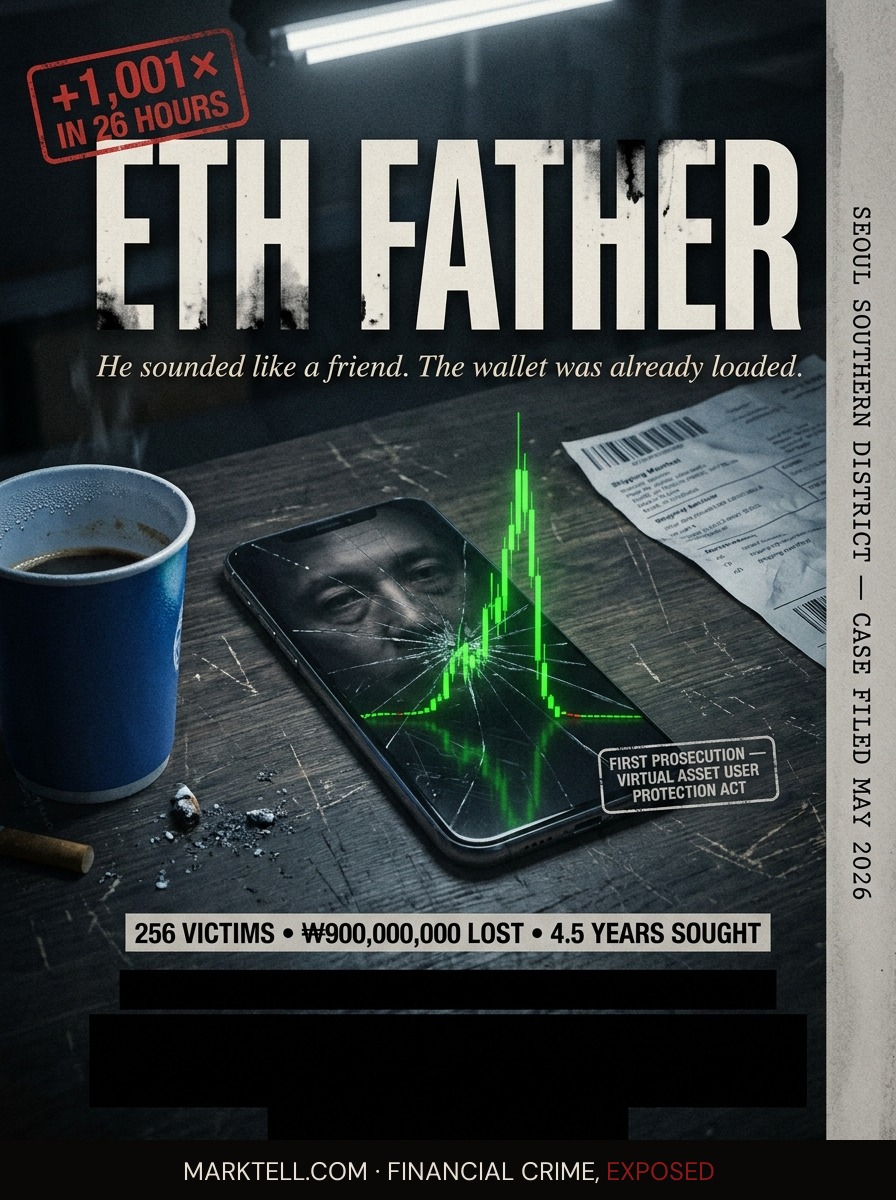
Min-jun was thirty-four and on his second cup of instant coffee when the candle turned green again.
He worked logistics out of a warehouse near Incheon Port, the shift that started at ten and ended when the trucks stopped coming. His phone lived face-up next to the keyboard. On slow nights, between the manifests, he watched charts.
The chart he was watching that night was called CATFI.
It had launched on Pump.fun a few hours earlier. Pump.fun is a website. That is the cleanest way to say it. You go to the site, you type a name, you upload an image, and the site mints a token for you on the Solana blockchain and puts it on a trading curve. The whole thing costs a few dollars. You do not need a company. You do not need a lawyer. You do not need anyone's permission. By the time Min-jun found CATFI, the token had been alive for about ninety minutes and was already up several hundred percent.
He bought a small position. He told himself it was a small position. It was not the smallest position he had ever taken.
By dawn, the chart had moved 1,001 times. That is the number prosecutors used. One thousand and one times its launch price, in twenty-six hours.
Min-jun did not sell at dawn. Almost nobody who bought CATFI sold at dawn. The people who sold at dawn were the people who had built the launch.
I.
Here is what South Korean prosecutors say happened, and here is what they are now asking a court to do about it.
In late May 2026, the Seoul Southern District Prosecutors' Office filed charges against five people connected to CATFI. The lead defendant, identified in Korean filings by the surname Park, is the one prosecutors want for 4.5 years. According to those filings, Park ran a social media persona called "Eth Father." On Korean crypto channels and Telegram groups, "Eth Father" presented as an independent crypto influencer, the kind of voice that points out tokens before they move.
Prosecutors allege he was not pointing. He was loading.
The arithmetic in the indictment is small and brutal. The group spent roughly ten million won, around seven thousand two hundred dollars, to issue the CATFI token and seed its first buys. They drew in about six thousand investors. Two hundred and fifty-six of them lost a combined nine hundred million won, around six hundred thousand dollars. The operators allegedly cleared four hundred million won, around two hundred and eighty thousand dollars, in profit before the chart went vertical and then went to nothing.
The market cap touched $8.99 million in February 2025. By the next week it was around fifty-seven thousand. Not a correction. Not a pullback. A 99% drop.
That is not a price chart. That is a stage being torn down after the audience leaves.
II.
To understand what Min-jun was actually holding, you have to understand the launch pad.
Pump.fun is not a fraud. Pump.fun is a tool. The distinction matters because the tool is doing exactly what its design promises. You can issue a token there in less time than it takes to make rice. The token gets a trading curve. The curve means the price goes up as people buy and down as people sell, on its own, without any market makers or order books. The early buyers, by definition, get the cheap end of the curve.
Now picture you are the launcher. You mint the token. You hold a wallet with most of the supply. You also hold a few other wallets, funded quietly through different on-ramps, that will pose as separate buyers. You buy with those wallets. The price moves. You start posting screenshots. You write threads on social media about how this token is "early" and the chart is "based." You give the persona a name. "Eth Father." You sound like a friend.
People show up. The price moves more. The chart turns into the kind of green that wakes people up at three in the morning to check their phones.
Then you sell.
Not slowly. Not visibly. You sell into the buyers, from the wallets you control, until the floor is gone. The persona goes quiet. The Telegram channel keeps scrolling. Most of the people in it never figure out who took their money. They know it is gone. They do not know whose hand moved last.
The Virtual Asset User Protection Act, which took effect in July 2024, is the law South Korea passed to put a name on this. The act calls it market manipulation. It allows prison terms of at least one year. If illegal gains exceed about five billion won, roughly $3.76 million, the operator can face a life sentence.
CATFI did not hit those numbers. CATFI is the smaller, earlier kind of case. That is part of why it matters. It is the first prosecution of a decentralized exchange rug pull under the new act. The prosecutors are not after the biggest fish. They are setting the precedent on a fish the size of a memecoin.
III.
Min-jun's screen lied to him in a very specific way.
It did not lie about the price. The price was real. The chart was not faked. The candles climbed exactly the way the candles claimed to climb. Anyone with a block explorer could have looked at the wallet distribution and seen something was wrong, that one cluster held most of the float, that the buys feeding the curve were coming from a small number of related addresses.
He did not look. Most people do not look. Looking is not what the screen is for. The screen is for the chart, and the chart was doing what charts do when they are working.
That part may be the saddest. The user interface of the trade is the lie. The truth lives on a different page, in a tool the average buyer has never opened, in a layout the average buyer cannot read.
By the time the analysts at firms like Bubblemaps traced the dump back through the linked wallets to the "Eth Father" persona, the holders were already holding nothing. On-chain analysis is good at autopsy. It is not as good at warning.
Min-jun did not lose his apartment. He did not lose his job. He lost an amount of money he can describe to himself in the dark but cannot describe to his wife. He lost the version of himself that thought he had figured out a small edge between the trucks. He kept the phone. He stopped opening the trading app for a while. Then he opened it again. That is how this usually goes.
IV.
What the Seoul prosecutors are asking the court to do, in plain terms, is to count this kind of harm as harm.
Not unfortunate. Not a risk the buyer accepted. Harm, with a perpetrator, with a sentence attached. 4.5 years for Park. Charges against four others, two in custody, two indicted without detention. Two additional accomplices reportedly under investigation for allegedly helping the suspects evade arrest.
The Financial Supervisory Service has spent the year since the act took effect issuing warnings about exactly the pattern CATFI ran. On June 15, the FSS told retail investors plainly that memecoin launches on decentralized exchanges were producing rug pulls in volume. It is not a new pattern. It is a pattern that now has a law attached to it in at least one country.
That is what is new here. Not the trick. The trick is old. A token with no business, a chart shaped like a wave, a persona built to be trusted, a wallet built to leave. The trick has been running under different names since long before Solana existed.
What is new is that a prosecutor in Seoul is standing in a courtroom asking for 4.5 years on behalf of two hundred and fifty-six people who watched their phones in the dark.
Min-jun is not one of the named victims. He is the composite of them. He is also, statistically, the next one, because the launch pad is still running and the persona is cheap to build and the law is only one law in one country.
The candle was green. The wallet was loaded. The man at the top of the curve had a name that sounded like a father.
He just was not yours.
- Bitcoin World / Google News | June 30, 2026 | "South Korea Seeks 4.5-Year Sentence For CATFI Memecoin Rug Pull Mastermind"
- Seoul Southern District Prosecutors' Office | May 2026 | Indictment of five individuals in CATFI case (as reported)
- Republic of Korea | July 2024 | Virtual Asset User Protection Act, effective date and penalty structure
- Financial Supervisory Service (FSS), South Korea | June 15, 2026 | Investor warning on memecoin rug pulls on DEXs
- Bubblemaps / Nick Vaiman public commentary | 2026 | On-chain analysis of CATFI wallet cluster
- Pump.fun platform documentation | public | Token launch mechanics on Solana
Editorial Notice
MarkTell is a true crime publication about financial fraud. Some scenes, dialogue, and sequential details are reconstructed from court filings, enforcement actions, news reports, and public records. Where the public record does not provide exact details, editorial reconstruction is used to convey the documented pattern of events. Names of private individuals may be changed to protect identity. All factual claims are sourced to public documents cited in the Evidence Trail above. MarkTell does not provide investment, legal, or financial advice. Nothing published here constitutes a recommendation to buy, sell, or avoid any investment. Allegations described in active cases have not been adjudicated and defendants are presumed innocent until proven guilty. Readers should conduct their own due diligence before making financial decisions.