The price on the Seoul screen moved because someone in another country needed it to
South Korean regulators sent two alleged crypto market manipulators to prosecutors this week. One of them, they say, bought roughly half a token's global supply on foreign exchanges, then bled it out onto Korean screens where the buyers were waiting.
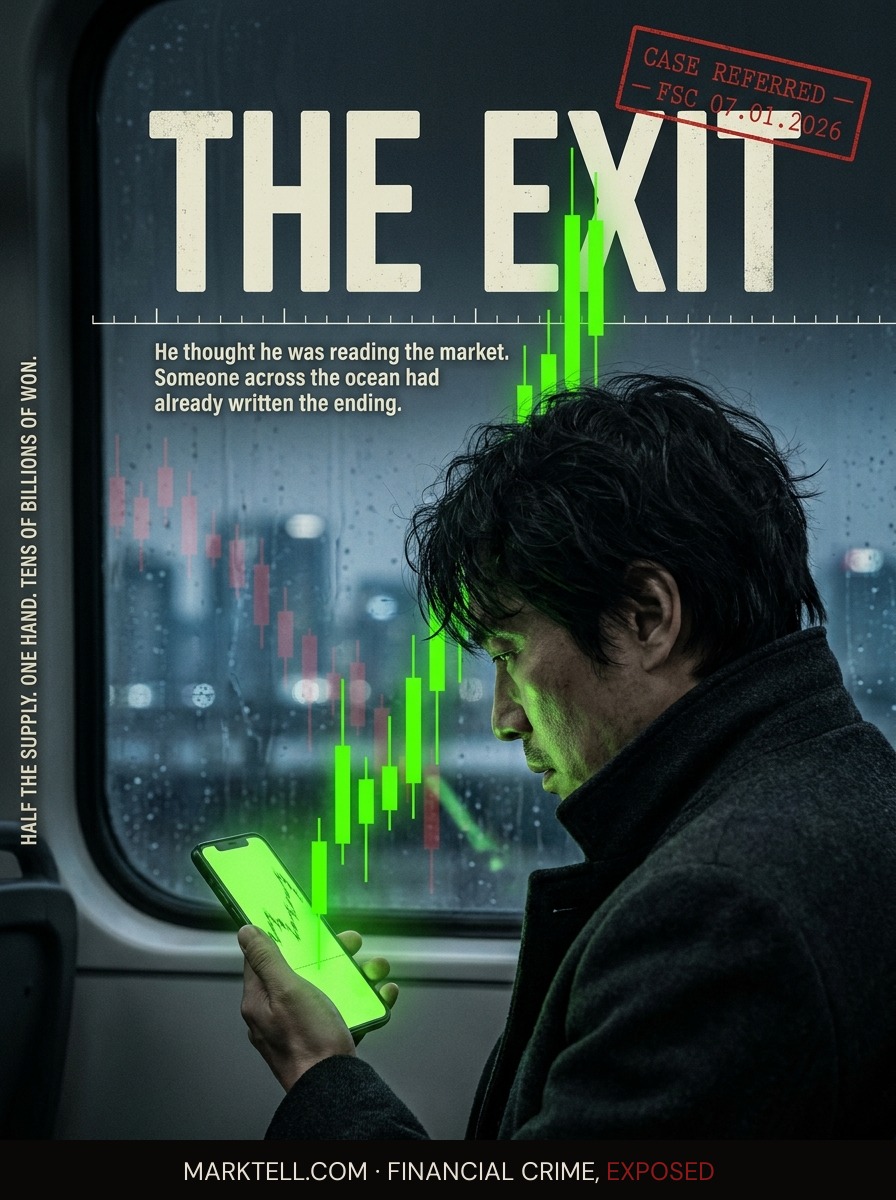
Jun-ho is thirty-four. He works logistics at a freight forwarder near Incheon Port. On the 7:42 train into Seoul he has a habit. He opens his phone, he opens the app, and he looks at the overnight candles.
That morning the candle he was watching was green. Not a small green. A green that filled the screen. The token had been sleeping for weeks. Now the price on the overseas exchange was up almost forty percent while Seoul had barely moved.
He switched tabs. Upbit. Same token. The Korean price was lagging. He watched the ask side of the order book thin out. He watched Korean buyers walk up the ladder. He tapped in the amount he could spare from the month. He confirmed. The train pulled into Yongsan.
He did not know that on the other side of the trade, on the other side of the ocean, a person the Financial Services Commission would eventually call Suspect A had already spent tens of billions of won accumulating the token. He did not know that same person had allegedly acquired roughly half of the token's global circulating supply. He did not know the green candle he was chasing was not a market signal. It was a purchase order that had been written weeks earlier by the person now waiting on the other end of his click.
He was not stupid. He was reading a chart. The chart was the crime scene.
I.
On July 1, 2026, South Korea's Financial Services Commission referred two cases of alleged crypto market manipulation to prosecutors. Under the Virtual Asset User Protection Act, which took effect on July 19, 2024, the regulator now has statutory teeth for what used to be a market that policed itself in Telegram groups.
The first case is the one you need to understand. According to the FSC, Suspect A spent about two months building a position in a token that was listed on both overseas and Korean exchanges. The suspect allegedly injected tens of billions of won into the trade and, at the peak of the accumulation, held roughly half of the token's circulating supply worldwide.
Read that slowly. Half the supply. One hand.
The next step is the one that makes the machine work. Prices on dual-listed tokens move together. If a coin runs on Binance, the Korean exchanges see it and the Korean exchanges chase. Traders in Seoul call the gap between the two prices the kimchi premium. On a good day the premium is positive, meaning Koreans are paying more. On the day of a pump, the premium is a lever.
Suspect A allegedly ran the price up on the overseas venues. The Korean exchanges followed. And then, on the domestic side, where the Korean retail buyers were watching charts on trains and in break rooms and on couches, Suspect A sold. The regulator says the seller booked losses overseas and profits in Korea. The losses were the cost of running the pump. The profits were the point. The damage was concentrated on Korean investors.
That is the machine. Two screens, one hand. The screen abroad was the stage. The screen at home was the checkout counter.
II.
The second case is faster and dumber and more common.
Suspect B, the FSC says, targeted kimchi coins. That is the domestic term for tokens that trade almost exclusively on Korean exchanges and rarely anywhere else. Thin books. Small crowds. Easy to move.
The alleged method was API abuse. An API is the wire that lets a trading program talk directly to an exchange without a human clicking buttons. Suspect B is accused of pushing buy orders and sell orders through the API within one second of each other, over and over, to create the appearance of active trading. At the same time, through the regular web interface, higher-priced buy orders were being placed to push the tape up.
Then the position was sold in tranches. Small chunks, one after another, into whatever appetite the fake activity had summoned.
This kind of scheme is not new. In January 2025, the first case ever prosecuted under the Virtual Asset User Protection Act involved a suspect who allegedly earned several billion won in unjust gains over one month, sometimes completing the whole cycle in ten minutes. Ten minutes. That is the length of a train ride between two stops on the Seoul metro. That is the length of Jun-ho's commute from where he decides to buy to where he steps off the train.
III.
The Financial Supervisory Service runs a reporting center for virtual asset abuse. In the first five months of 2026 alone, the center received 54 reports. Fifty of them were about price manipulation. For all of 2024, the total was 55. For all of 2025, it was 30.
Do the math. Five months of 2026 nearly equal all of 2024. The reports are not surging because the manipulation is new. The reports are surging because there is finally a place to send them and a law that treats them as crimes.
That is progress. It is also a map of how much of the tape you have been watching was not a market.
IV.
Jun-ho did not check the app until he got home that night. He had a rule about not looking during the workday. The rule was the only thing that had kept him solvent through 2024.
The number on his screen was smaller than the number he had put in that morning. Not catastrophically smaller. Just smaller in the way that a small cut is not a wound but is still bleeding on the counter. The candle he had chased was red now. The Korean price had converged with the overseas price the way it always eventually does, and someone else was holding the token, and he was holding the receipt.
He did what marks do. He checked the chart. He looked for a reason. He read the Telegram group for the coin. Somebody in there said it was manipulation. Somebody else said hold. He put the phone face down on the kitchen table.
The kitchen table is where these stories always seem to end up. Not the boardroom. Not the courtroom. The kitchen table at 11 p.m. with a phone face down and a spouse asleep in the next room.
V.
Here is the part that matters for the next time.
The pump-and-dump on a dual-listed token is not a Korean problem. It is a physics problem. Any asset that trades in two places at once, in two currencies, with retail on one side and a whale on the other, is a candidate. The kimchi premium is one version. The gap between a Binance listing and a Nasdaq ADR is another version. The gap between a token's price on a decentralized exchange and its price on a centralized one is a third.
The ugly question is not "was that green candle real." The ugly question is "who benefits if I chase it."
If the answer is "the person who put the candle there," you are not the trader. You are the exit.
The FSC's Suspect A is alleged to have understood this in a way most retail buyers never will. The overseas losses were not losses. They were marketing spend. The advertising budget for the pump was the money burned lighting up the foreign chart. The revenue was the Korean order book.
That is the renaming that has to happen before you look at your next chart. The green candle abroad is not information. It is an invitation. Sometimes the invitation is honest. Sometimes it was written by the person waiting for you to accept.
Jun-ho does not know whether the token he bought was the one the FSC referred to prosecutors on July 1. Neither do I. The regulator has not named the coin. The suspects are letters, not names. The cases will move through the Korean prosecutor's office at the speed the Korean prosecutor's office moves, which is not the speed of the chart.
What we know is this. On July 1, 2026, the government of South Korea told two people that the tape they were writing was a crime. Somewhere in Incheon, on a train, someone was still reading it as a price.
- The Block | July 1, 2026 | "South Korea moves to prosecute crypto whale for alleged pump-and-dump scheme" | https://www.theblock.co/post/406834/south-korea-prosecute-crypto-whale
- Financial Services Commission (South Korea) | July 1, 2026 | Referral of two virtual asset market manipulation cases to prosecutors
- Virtual Asset User Protection Act (VAUPA) | Effective July 19, 2024
- Financial Supervisory Service | 2024-2026 | Virtual Asset Unfair Trading Report Center statistics
- Financial Services Commission | January 2025 | First VAUPA prosecution referral
Editorial Notice
MarkTell is a true crime publication about financial fraud. Some scenes, dialogue, and sequential details are reconstructed from court filings, enforcement actions, news reports, and public records. Where the public record does not provide exact details, editorial reconstruction is used to convey the documented pattern of events. Names of private individuals may be changed to protect identity. All factual claims are sourced to public documents cited in the Evidence Trail above. MarkTell does not provide investment, legal, or financial advice. Nothing published here constitutes a recommendation to buy, sell, or avoid any investment. Allegations described in active cases have not been adjudicated and defendants are presumed innocent until proven guilty. Readers should conduct their own due diligence before making financial decisions.