The invoice was real. The bank account belonged to someone else.
Kelvin Owusu Nkwantabisa got 204 months in a Florida federal court for leading a $38 million email hijacking ring. The mechanism he ran is still sitting inside every accounts-payable inbox in America.
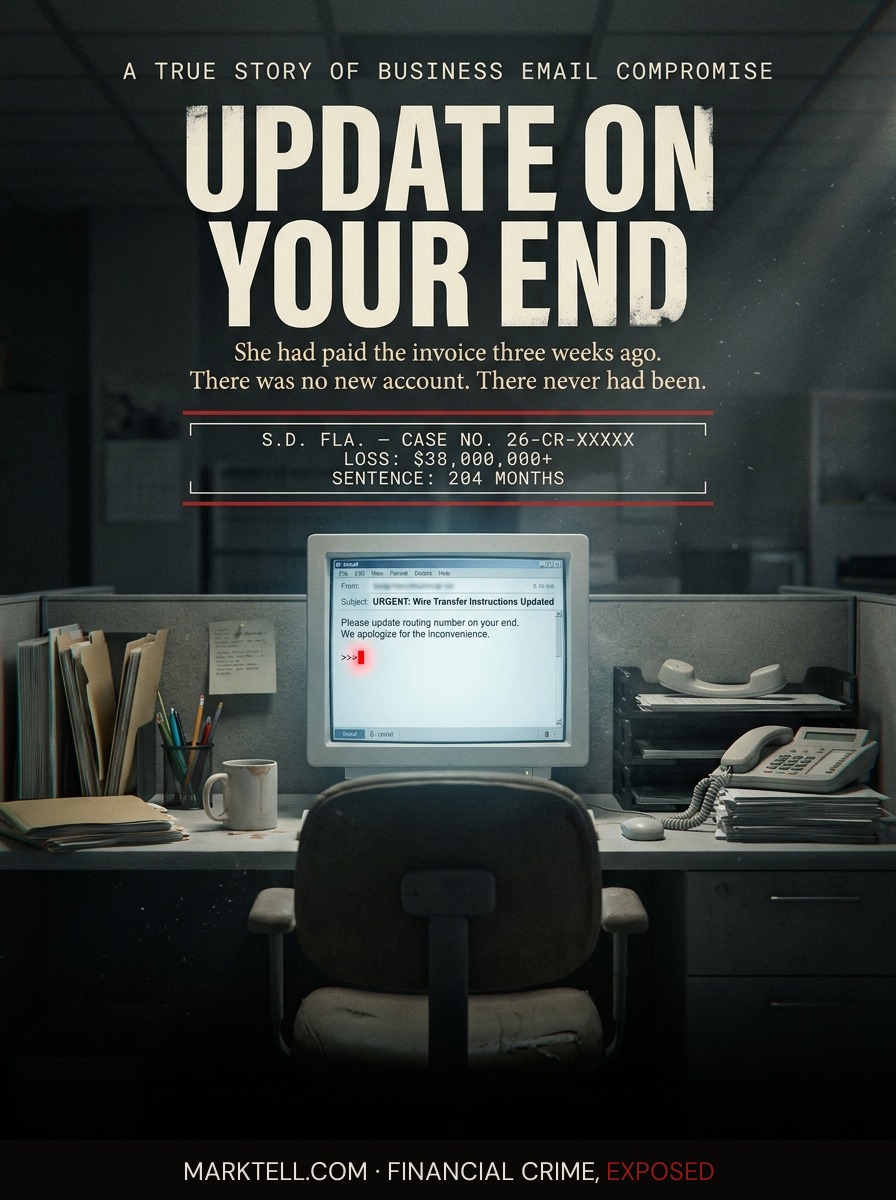
Marlene got to her desk at 7:42 in the morning, which was the same time she always got to her desk. Twenty-two years at the same company. A small chemicals distributor in Coral Springs, Florida, two miles from the highway, with a parking lot that flooded when it rained hard. She was the controller. She had three monitors and a coffee mug from her son's college and a pen cup with eleven pens in it, only four of which worked. She kept the working pens on the left.
The email was already in her inbox. It was sitting on top of a thread she had been reading for nine days. Same vendor. Same contact. Same signature block with the same misspelling in the address line she had noticed years ago and never mentioned because it would have been rude. The invoice was for $412,000 and change. She had budgeted for it. She had countersigned the purchase order. She had spoken to the vendor's accounts team on the phone two weeks earlier about a delivery date.
The new email said the old account was being audited. New routing number attached. Please update on your end. We apologize for the inconvenience.
She updated on her end. She approved the wire at 9:18 AM. She drank her coffee. She moved on to the next thing.
That is how it works. That is the whole machine. There is no boiler room. There is no pitch. There is no voice on the phone telling you about a once-in-a-lifetime opportunity. There is only an email that looks like the last email, sent from inside a thread that has been real for weeks, asking for a small change to a number that nobody verifies because nobody has ever needed to verify it before.
I.
The man behind the email was named Kelvin Owusu Nkwantabisa. He was 33 years old, a Ghanaian-American citizen who lived in Georgia and used the names Kevin Brown and KO when he was working. On January 12, 2026, a federal judge in the Southern District of Florida sentenced him to 204 months in prison. That is seventeen years. The U.S. Attorney's office put the total loss at more than $38 million across the United States and several other countries.
He did not work alone. Court records identify three co-defendants. Leshea Moore, 29, of Georgia, got more than eleven years. She built shell companies and opened the bank accounts that received the money. John Jouissance, 33, of Ohio, got four years for the same kind of work. Justice Amoh, 37, of New York, used the name Samuel Andrews and got three years for opening accounts under fake identities and moving the wires through them at Nkwantabisa's direction.
The Southern District of Florida ran the prosecution. Homeland Security Investigations out of Fort Lauderdale ran the case. The U.S. Attorney, Jason A. Reding Quiñones, said in a statement that the defendants exploited trust and legitimate business relationships to execute large-scale fraud. He said it the way prosecutors say things, which is plainly, with no adjectives. But read it again. Exploited trust. Legitimate business relationships. That is not a description of a crime. That is a description of a machine that uses ordinary commerce as fuel.
II.
The technical name for what Nkwantabisa did is Business Email Compromise. BEC. Say the letters out loud. They sound like nothing. That is part of why it works.
Here is what BEC is, in plain English. A criminal gets inside an email account. Sometimes by phishing. Sometimes by buying credentials on a market. Sometimes by guessing a password that should not have been guessable. Once they are inside, they do not do anything. They read. They sit in the account for days or weeks and they read the threads. They learn who pays whom. They learn how the invoices are written. They learn the cadence of the relationship. They learn which vendor calls the CFO by her first name and which one signs off with "thanks again." They learn the misspellings.
Then they wait for the right invoice. A big one. A scheduled one. A predictable one.
Then they step into the conversation, wearing the email account like a coat, and they ask for the routing number to be changed.
The FBI's Internet Crime Complaint Center put U.S. BEC losses at about $2.9 billion in 2024 alone, with global losses over the past decade above $55 billion. The average loss per incident was $137,000, up 83 percent from 2019. Read those numbers slowly. That is the second-costliest category of cybercrime in the country, behind only investment fraud. It runs on email. It does not require a phone room. It does not require a website. It does not require a single sales call.
It requires that someone in accounts payable update on their end.
III.
Marlene found out three weeks later. The real vendor called. The voice on the phone was the same voice she had spoken to about the delivery date. He was friendly the way he was always friendly. He said he hated to bother her but the $412,000 invoice was now past due and could she check on it.
She said she had paid it.
He said he had not received it.
She said she had paid it three weeks ago to the new account.
He said there was no new account.
There is a small physical moment that I want you to picture, because it is the moment that matters in every BEC case I have ever read. The controller, the bookkeeper, the office manager, the lawyer's assistant. The person whose job is to be careful. They are sitting at their desk holding the phone. They are looking at their own monitor. They are pulling up the wire confirmation. The routing number is right there on the screen. It is real. The wire went somewhere. Their hands are not shaking yet, because their brain has not finished assembling what happened.
Then it finishes assembling.
That is the moment the machine becomes visible. Not before. There is no warning. There is no red flag the day of the wire. The flags are all behind you, in the threads you have already read, in the small things you did not notice because you are not paid to notice them. You are paid to pay invoices.
IV.
The money did not go into one account. It never does. According to the federal record, Moore and Jouissance and Amoh opened bank accounts across multiple states under shell company names. The wires came in, sat for a beat, and moved. To another account. Then another. Then to cards. Then to crypto, sometimes. Then to people overseas whose names the U.S. record does not contain because they are outside U.S. jurisdiction and the indictment does not reach them.
This is called layering. It is the part of money laundering that exists to make the money tired. Each hop strips off a little context. By the time the money reaches the people who actually directed the fraud, the trail behind it looks like noise.
Nkwantabisa, the record says, coordinated with the overseas accomplices. He directed where the accounts should be opened. He watched for the incoming wires. He told the co-defendants what to do once the money landed. He was, in the prosecutor's framing, the U.S.-based leader of the U.S.-based arm of the operation. There is another arm. That arm is still out there.
V.
I want to be careful here, because the temptation in a story like this is to make Nkwantabisa the whole story. He is not the whole story. He is the part of the story that got caught.
The machine is the story. BEC is a machine that runs on three things. It runs on email accounts that can be compromised, which is most of them. It runs on accounts-payable processes that do not require a phone call to verify a change in payment instructions, which is most of them. And it runs on the basic human assumption that the person on the other end of a long email thread is the same person you have been talking to the whole time.
Every one of those three things is a design choice. Every one of those three things can be changed. The reason BEC keeps working is that the cost of changing them, for any one company, is higher than the cost of the next fraud. Until it isn't.
This is what experts mean when they say the financial system is partially complicit in its own exploitation. It is not a moral statement. It is an engineering statement. The pipes were built before the criminals knew how to use them. Now the criminals know.
VI.
Marlene is a composite, but the company in Coral Springs is real, and the law firm in Mooresville, North Carolina, is real, and the corporation in Suffolk, England, is real, and the company in Elizabeth, New Jersey, is real, and the investor in Auckland, New Zealand, is real. Those are the victims the federal record names. There are others it does not name.
The restitution hearing was scheduled for April 10, 2026. Restitution hearings in BEC cases are usually quiet affairs. The money is gone. Most of it is overseas. Some of it is in cards that were spent at retailers that do not give it back. Some of it is in crypto that has been swapped through mixers. What victims usually get is a number on paper and a slow trickle that adds up, over years, to a fraction of what they lost.
The seventeen-year sentence is real. The money is mostly not coming back.
I have been writing about sales floors and phone rooms and pitch decks for a long time. BEC is not a pitch. There is no charisma. There is no story. There is no five-hour presentation with the pen uncapped at hour five. There is only a thread of emails that already existed, and a stranger sitting inside it, waiting for the invoice that is big enough to be worth stealing.
The crime scene is the inbox. The mark is the person who reads every invoice twice. The pen at hour five is the line in the email that says we apologize for the inconvenience.
VII.
Marlene still works at the company. The company survived. Most do, but not all. She does not approve a wire anymore without picking up the phone and calling the vendor at the number she has in her own contacts, not the number in the email signature. She makes the call even when it is awkward. She makes the call even when the vendor sounds annoyed. She makes the call because she now understands what she did not understand on the morning she updated on her end.
The email was real. The thread was real. The vendor was real.
The bank account was someone else's.
- U.S. Attorney's Office, Southern District of Florida | January 12, 2026 | Sentencing announcement, United States v. Kelvin Owusu Nkwantabisa
- MyNewsGh | June 2026 | "BREAKING: US Court Jails Ghanaian Kelvin Owusu Nkwantabisa To 17Yrs Over $38M Fraud"
- Homeland Security Investigations, Fort Lauderdale | 2026 | Case investigation record
- FBI Internet Crime Complaint Center (IC3) | 2024 Annual Report | BEC loss statistics
- U.S. Department of Justice | 2026 | Co-defendant sentencing records: Leshea Moore, John Jouissance, Justice Amoh
- U.S. Attorney's Office, Northern District of Ohio | May 14, 2026 | Indictment of Jamal Abubakari, Kamal Abubakari, Amanda Joy Opoku-Boachie (referenced for pattern context)
Editorial Notice
MarkTell is a true crime publication about financial fraud. Some scenes, dialogue, and sequential details are reconstructed from court filings, enforcement actions, news reports, and public records. Where the public record does not provide exact details, editorial reconstruction is used to convey the documented pattern of events. Names of private individuals may be changed to protect identity. All factual claims are sourced to public documents cited in the Evidence Trail above. MarkTell does not provide investment, legal, or financial advice. Nothing published here constitutes a recommendation to buy, sell, or avoid any investment. Allegations described in active cases have not been adjudicated and defendants are presumed innocent until proven guilty. Readers should conduct their own due diligence before making financial decisions.