The hotline that did not exist while the app kept promising it did
Forty-six state attorneys general say Cash App sold a safety it never built. The $45 million settlement is the receipt for what happened to the people who believed the pitch.
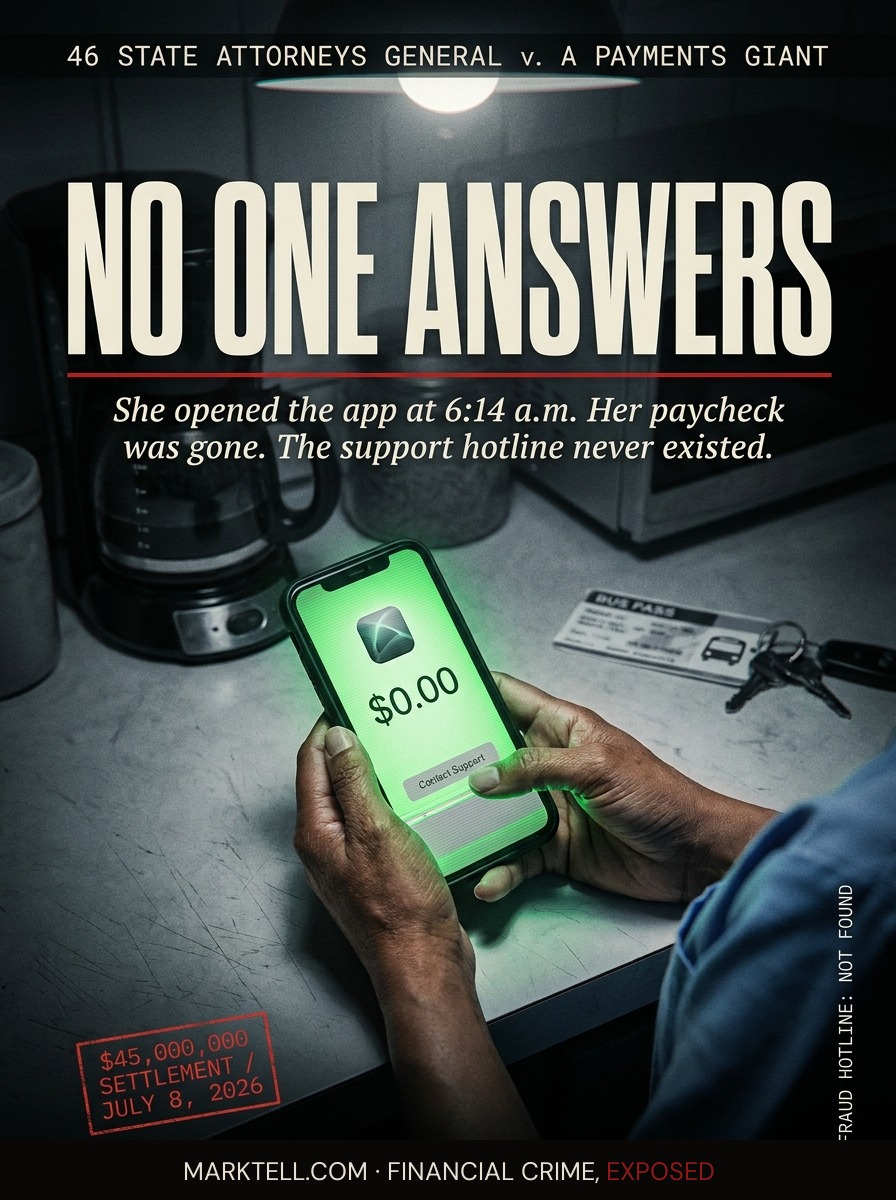
Denise picked up her phone at 6:14 a.m. because the coffee maker was slow and she had ten minutes before the bus. She was fifty-eight, worked home health in a Cleveland suburb, and had switched her direct deposit to Cash App four months earlier because her credit union had charged her $12 in overdraft fees on a $9 debit. She had done the math on the bus. Cash App was free. Cash App gave her the money the same day. Cash App had a green logo on the side of the bus she rode to work.
She opened the app.
$0.00.
The night before, the screen had said $1,847.23. Rent was due Friday. Her car payment cleared automatically on the tenth. She stood in the kitchen in her scrubs and she did the thing everyone does. She closed the app. She opened it again. She pulled down to refresh. She turned the phone off and back on. The number did not move.
She tapped Support.
There was no phone number. There was a message form. She typed what had happened. The app said someone would respond. She missed the bus.
I want to stop here because this is the piece of the story the settlement is actually about. Not the money that left her account. The room she walked into looking for help and finding a message form.
For years, according to the coalition of forty-six state attorneys general who announced a $45 million settlement with Block Inc. on July 8, 2026, Cash App did not have a working fraud hotline. Users who searched Google for one were routed to numbers scammers had bought ads against. The scammers would answer the phone with a script. They would ask for the login. They would drain what was left.
That is not a customer service failure. That is a stage set.
I.
The pitch was simple and the pitch was everywhere. Cash App is easy. Cash App is fast. Cash App works like a bank without acting like one. There were Super Bowl ads. There was Cash App Fridays, a promotion that gave away money to users who tagged the app on social media, which turned every Friday into a fishing hole for scammers who set up fake giveaway accounts and asked people to send $5 to unlock $500. The AGs cite Cash App Fridays specifically. The promotion kept running while the fraud reports kept climbing.
The sign-up took under two minutes. The identity verification was minimal. Regulators say this is not an accident. A frictionless door is a business decision. It brings in users. It also brings in the people who want to open accounts in other people's names.
Denise was not the target of a sophisticated attack. She was the target of a machine that had already decided her category was acceptable loss.
II.
The state findings, filed with the settlement, allege a pattern that repeats across every failure they list.
Block claimed cutting-edge fraud detection. The AGs allege the systems were inconsistent and, in some periods, effectively absent.
Block implied Cash App offered protections comparable to a bank account. The AGs allege it did not.
Block operated without a functioning fraud hotline. Users who could not reach the company through the app went to Google. Scammers were waiting there.
Block knew fraud was rising. Marketing kept expanding.
Block targeted unbanked and underbanked customers for direct deposit. Those customers had no cushion when the money moved.
Read that list slowly. Every item is one decision. Together they are not a mistake. They are the shape of a company that grew faster than the safety it advertised.
The $45 million is split among the participating states. New York receives $1.6 million. Oregon, which co-led the investigation with Texas, receives $3 million. Washington receives $1.8 million. Pennsylvania receives $1,137,695.72. Massachusetts $730,000. New Jersey $892,753.12. Nebraska $379,619.99. The precision of those numbers is the tell. Somebody counted.
III.
This is not Block's first check.
On January 16, 2025, the Consumer Financial Protection Bureau ordered Block to distribute between $75 million and $120 million in consumer redress and to pay a $55 million civil money penalty for what the Bureau described as failures around Cash App fraud response and dispute resolution. That same month, Block paid $80 million to 48 state financial regulators for violations of the Bank Secrecy Act and anti-money laundering rules. In April 2025, the New York Department of Financial Services took another $40 million for compliance failures. Washington State has a separate $20 million settlement over unemployment deposits that moved through Cash App during the pandemic and did not always reach the people whose names were on them.
Add it up. Over $200 million in penalties and redress across eighteen months, not counting Washington's unemployment case.
And on July 7, 2026, the day before the multistate settlement was announced, a Block executive named Brian Grassadonia sold 43,348 shares of Class A Common Stock at $80.00 per share under a pre-arranged 10b5-1 plan. That is a routine, legally permitted sale scheduled in advance. It is also the kind of ordinary calendar detail that lives next to the settlement date the way coffee cools on a desk while a wire clears.
The stock is up roughly 19 percent on the year. Goldman Sachs put Block on its US Conviction List on June 1, 2026, with a $95 price target. Morgan Stanley raised its target to $98. The market has decided the penalties are the cost of doing business.
They are. That is the whole point.
IV.
Denise got her money back eventually. Not from Cash App. From a chargeback her debit card issuer processed after she filed a police report and waited three weeks. She moved her direct deposit back to the credit union. The $12 overdraft fee looks different now.
She still uses the app for small things. Splitting a pizza. Sending her niece twenty dollars for a birthday. She does not keep a balance in it anymore. She learned that lesson the way people learn most lessons about money in this country. In her kitchen. At 6:14 a.m. In scrubs.
The settlement does not require Block to admit wrongdoing. It rarely does. It requires the company to build the things it said it already had. A fraud hotline that works. A dispute process that resolves. Identity verification that verifies. The consent order is essentially a list of features Cash App claimed to offer and now has to build.
Read that sentence again.
The state attorneys general made Block promise to build what its marketing already promised.
V.
There is a version of this story that ends with the number. Forty-five million. A big check. A win for consumers. Move on.
That is not the story.
The story is that a payments app grew to hundreds of millions of users on the strength of a pitch about safety, and the pitch was, according to forty-six state attorneys general, not true. The story is that the people who got hurt were the people the marketing specifically targeted. The unbanked. The underbanked. The ones for whom $1,847 was rent and a car payment and groceries and nothing left over.
The story is that Denise walked into a room looking for help and the room had been designed without a door.
The green logo is still on the bus.
- The Block | July 8, 2026 | https://www.theblock.co/post/407623/cash-app-owner-block-pay-45-million-states-say-it-made-false-security-promises
- Office of the New York Attorney General | July 8, 2026 | Multistate settlement announcement
- Oregon Department of Justice | July 8, 2026 | Co-lead announcement with Texas AG
- Consumer Financial Protection Bureau | January 16, 2025 | Consent order against Block Inc. (Cash App), $55M penalty and $75M-$120M redress
- Conference of State Bank Supervisors | January 2025 | $80M multistate settlement for BSA/AML violations
- New York Department of Financial Services | April 2025 | $40M consent order
- Washington State Attorney General | 2024-2025 | $20M unemployment deposit settlement
- SEC Form 4 filing | July 7, 2026 | Brian Grassadonia, Block Inc.
- SEC Form 4 filing | July 6, 2026 | Roelof Botha, Block Inc.
- Goldman Sachs research note | June 1, 2026 | Block added to US Conviction List
- Morgan Stanley research note | June 2026 | Block price target raised to $98
Editorial Notice
MarkTell is a true crime publication about financial fraud. Some scenes, dialogue, and sequential details are reconstructed from court filings, enforcement actions, news reports, and public records. Where the public record does not provide exact details, editorial reconstruction is used to convey the documented pattern of events. Names of private individuals may be changed to protect identity. All factual claims are sourced to public documents cited in the Evidence Trail above. MarkTell does not provide investment, legal, or financial advice. Nothing published here constitutes a recommendation to buy, sell, or avoid any investment. Allegations described in active cases have not been adjudicated and defendants are presumed innocent until proven guilty. Readers should conduct their own due diligence before making financial decisions.