The congressman bet against himself. The market caught him in minutes.
A former congressman, a prediction market, and a State of the Union speech he said he would attend but didn't. Federal prosecutors are now asking whether the no-show was the trade.
Dwight was making coffee when he took the trade.
Fifty-eight years old. Twenty-six years at the post office in a town outside Dayton. Retired in 2024 with a pension that covered the mortgage and not much else. He had heard about Kalshi the same way most people heard about it. An ad on a podcast. A friend at the VFW who said you could bet on anything now, legally, regulated by the government. Not a casino. A market. That was the word the ad used. Market.
He put twelve hundred dollars in.
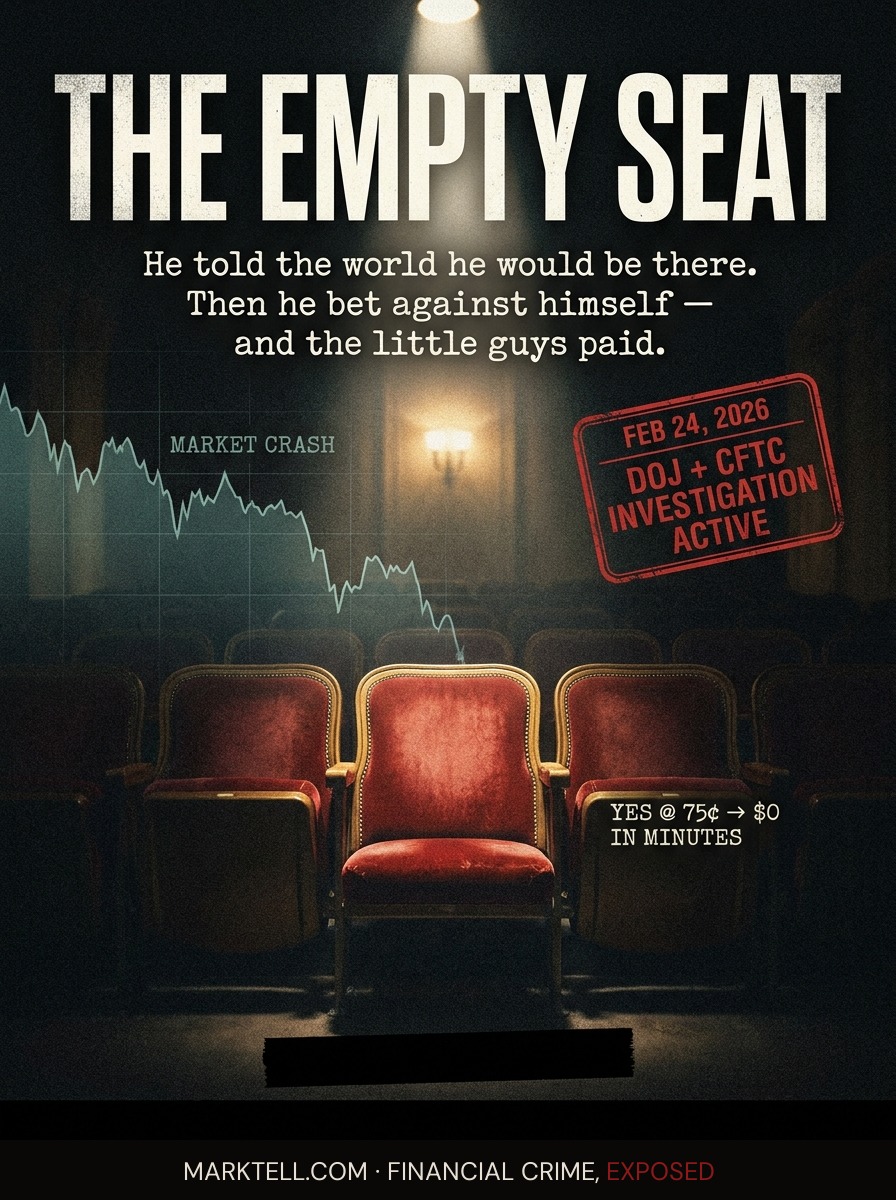
On the morning of February 24, 2026, he was scrolling the politics contracts. There was one he kept watching. Will George Santos attend the State of the Union address tonight. The YES side was trading at around seventy-five cents. The number had climbed all week because Santos had been telling anyone with a camera that he would be there. He had been expelled from Congress in 2023. He had pleaded guilty to wire fraud in 2024. He had been sentenced to seven years in 2025 and walked out after eighty-four days when the president commuted his sentence. He was a free man with nothing to do that night except show up.
Dwight bought YES at seventy-five cents. Two hundred contracts. He went to make the coffee.
The speech started at nine.
Minutes in, the odds on YES fell off a cliff. Not a slide. A drop. The number went from the seventies into the teens before Dwight had finished his first cup. He refreshed the page. He refreshed it again. He opened X. There was a post from Santos. He had been "waylaid at the airport." He was not going to make it.
Dwight watched his two hundred contracts settle at zero.
He did not lose his house. He lost a hundred and fifty dollars. That is not the part of this story that matters.
The part that matters is that somebody on the other side of that trade knew the answer to the question before the question was asked. And the somebody on the other side, according to a person familiar with the federal investigation now active at the Department of Justice and the Commodity Futures Trading Commission, was the man whose seat in the gallery the contract was about.
I.
Prediction markets sell themselves as oracles. The crowd is smart. The price is the probability. The wisdom of strangers, priced in cents, settled in cash. That is the pitch.
The pitch works only if no one at the table controls the answer.
A Kalshi contract is what the regulators call an event contract. You pay a price between one cent and ninety-nine cents for a YES or NO position on whether something will happen. If you are right, the contract settles at a dollar. If you are wrong, it settles at zero. The difference is your profit or your loss. Kalshi is licensed by the CFTC as a Designated Contract Market, which means it operates under the same anti-manipulation and anti-fraud rules that apply to futures exchanges. The CFTC has said publicly it has zero tolerance for insider trading on these venues. Kalshi's own rules prohibit any trader who is a "decision maker" or has "any influence, directly or indirectly" on an outcome from trading the related contract.
A man deciding whether to walk into a room is the decision maker for the contract on whether he walks into the room. There is no second interpretation of that sentence.
II.
The allegation, sourced to a person familiar with the matter and first reported by Reuters, is this. Santos told the public he would attend. The market moved on his statement. The YES price climbed to roughly seventy-five cents. Then, while the YES price was high, an account allegedly belonging to Santos took the NO side. When he posted minutes into the speech that he was stuck at the airport, the YES price collapsed and the NO position paid out. The reported profit is in the tens of thousands of dollars.
Read that slowly.
He moved the market with a public statement of intent. He bet against the statement. He resolved the market with a second public statement.
That is not a trade. That is a valve. One hand on the inlet. One hand on the outlet. The middle is where the money settles.
III.
Kalshi's surveillance caught it. That part is documented. The exchange froze the account around the end of February 2026 and referred the activity to federal prosecutors and to its own regulator at the CFTC. Kalshi has declined public comment on the specific matter. The DOJ has not commented. The CFTC has not commented. The investigation is active. No charges have been filed.
Santos has denied the allegations. He called them "preposterous." He told reporters he was unaware of the investigation until media accounts. He would not confirm or deny that he holds a Kalshi account. He volunteered that he knows Kalshi's co-founder, Luana Lopes Lara, a "fellow Brazilian," and said he intended to call her.
That is the answer of a man who has spent his adult life answering questions like this.
IV.
This is not the first time the prediction market industry has run into this problem in 2026. It is the fourth time the public can name.
In April, Kalshi disciplined three congressional candidates for betting on their own campaigns. Suspensions. Fines. The platform calling its own users out.
In April, a U.S. Army Master Sergeant was criminally charged for allegedly using classified military intelligence to profit more than four hundred thousand dollars on Polymarket trades tied to the capture of Venezuelan President Nicolás Maduro.
In May, Congress opened a probe into how Polymarket and Kalshi handle insider trading.
On the morning this story broke, June 4, 2026, nine Democratic lawmakers sent a letter asking the Federal Trade Commission to investigate whether prediction markets are advertising themselves as gambling to consumers while presenting themselves as financial exchanges to regulators.
That is a pattern. Five events in ninety days is a pattern. The valve has more than one operator. The valve has a category.
V.
Dwight does not know any of this when he closes his laptop on the morning of February 25. He knows what he saw. The price was seventy-five. The price went to zero. Santos did not show up. He thinks he made a bad bet on a man who was unreliable. He blames himself a little. He thinks he should have known better than to trust a guy with that record to keep his word.
That part may be the saddest. The mark blames himself for trusting the public statement. The whole machine works because he does.
The crowd is smart only when nobody at the table is reading the cards face up. Kalshi's surveillance worked the way it is supposed to work. The exchange caught it. The regulators were called. The system, for once, behaved.
But the trade still cleared. The money still moved. The YES holders on the other side were already paid out at zero before any of them learned what they had been on the other side of.
VI.
Here is the thing the prediction market industry will need to answer for, and not in court. In the room where the policy gets written.
A market for everything is a market for inside information about everything. If you let people trade contracts on whether a man walks into a room, the man who decides whether to walk into the room becomes the most valuable trader in the world. If you let people trade contracts on military operations, the people who run the operations become the market. If you let people trade contracts on elections, the candidates become the market. If you let people trade contracts on Supreme Court decisions, the clerks become the market.
The exchange becomes the venue where the people who already know come to monetize knowing.
The crowd, the wise crowd, the strangers in the ad, are the YES holders at seventy-five cents on the morning of February 24, 2026. They are Dwight at the counter with the coffee. They are the counterparty by design.
VII.
The man whose attendance was the question did not attend. The market that priced his attendance was the market he traded. The exchange that hosted the trade caught it and called the police.
He told reporters he was waylaid at the airport.
He was not at any airport.
He was at the valve.
- Reuters | June 4, 2026 | "DOJ investigating ex-US lawmaker Santos for insider trading on Kalshi, source says"
- U.S. Department of Justice | August 2024 | Santos guilty plea, wire fraud and aggravated identity theft
- U.S. District Court, Eastern District of New York | April 2025 | Santos sentencing, 87 months
- White House | 2025 | Presidential commutation of Santos sentence
- U.S. House of Representatives | December 1, 2023 | Resolution expelling Rep. George Santos
- CFTC | 2026 | Public statements on insider trading enforcement in event contracts; Kalshi DCM designation
- KalshiEX LLC | platform rules and trading guidelines, kalshi.com
- George Santos | public statements on X and to press, February-June 2026
- Congressional letter to FTC | June 4, 2026 | nine Democratic lawmakers on prediction market advertising
- U.S. Army Master Sergeant Polymarket case | April 2026 | DOJ charging documents
- Kalshi enforcement actions against congressional candidates | April 2026
Editorial Notice
MarkTell is a true crime publication about financial fraud. Some scenes, dialogue, and sequential details are reconstructed from court filings, enforcement actions, news reports, and public records. Where the public record does not provide exact details, editorial reconstruction is used to convey the documented pattern of events. Names of private individuals may be changed to protect identity. All factual claims are sourced to public documents cited in the Evidence Trail above. MarkTell does not provide investment, legal, or financial advice. Nothing published here constitutes a recommendation to buy, sell, or avoid any investment. Allegations described in active cases have not been adjudicated and defendants are presumed innocent until proven guilty. Readers should conduct their own due diligence before making financial decisions.