The check window at Pine Ridge had a name on it, and the name was hers.
For nearly seven years, TERO fee checks meant for the Oglala Sioux Tribe's general fund took a detour through a personal bank account in Porcupine, South Dakota. Buffy Redfish was sentenced on June 29 to six and a half years. The window she sat behind is the story.
Doreen is sixty-two. She has lived on Pine Ridge her whole life except for the two years she worked at a hospital in Rapid City in the nineties. She raised three kids in a house her father built. She sits on a folding chair at a community meeting in Kyle on a Tuesday night and listens to a man from the revenue department explain, again, why the road out to her cousin's place is still the road out to her cousin's place.
The general fund is short. It has been short. It will be short.
She has heard this speech before. The words change a little. The number at the end changes a little. The road does not change.
What Doreen did not know on any of those Tuesday nights, across nearly seven years, was that some of the money that should have been in the general fund was already spent. Not on a road. On a house. On vehicles. On a life two counties over.
The money had a specific path. It just was not the path everyone assumed.
I.
Every contractor working on the Pine Ridge Reservation pays a fee to the Tribal Employment Rights Office. TERO is the office that makes sure tribal members get first crack at jobs on tribal land. If you are a construction outfit putting up a building, running a utility line, laying pipe, you cut a check to TERO. The check is a cost of doing business on the reservation. The money is supposed to go to the tribe's general fund. The general fund is what pays for the road out to Doreen's cousin's place.
For seven years, some of those checks did not make it.
According to the federal indictment and the sentencing record from the U.S. District Court in South Dakota, Buffy Redfish worked inside the TERO office. Her job, in the plainest possible description, was to collect the contractor fee checks and hand them to the revenue department for deposit. That was the job. Take the envelope. Walk it down the hall.
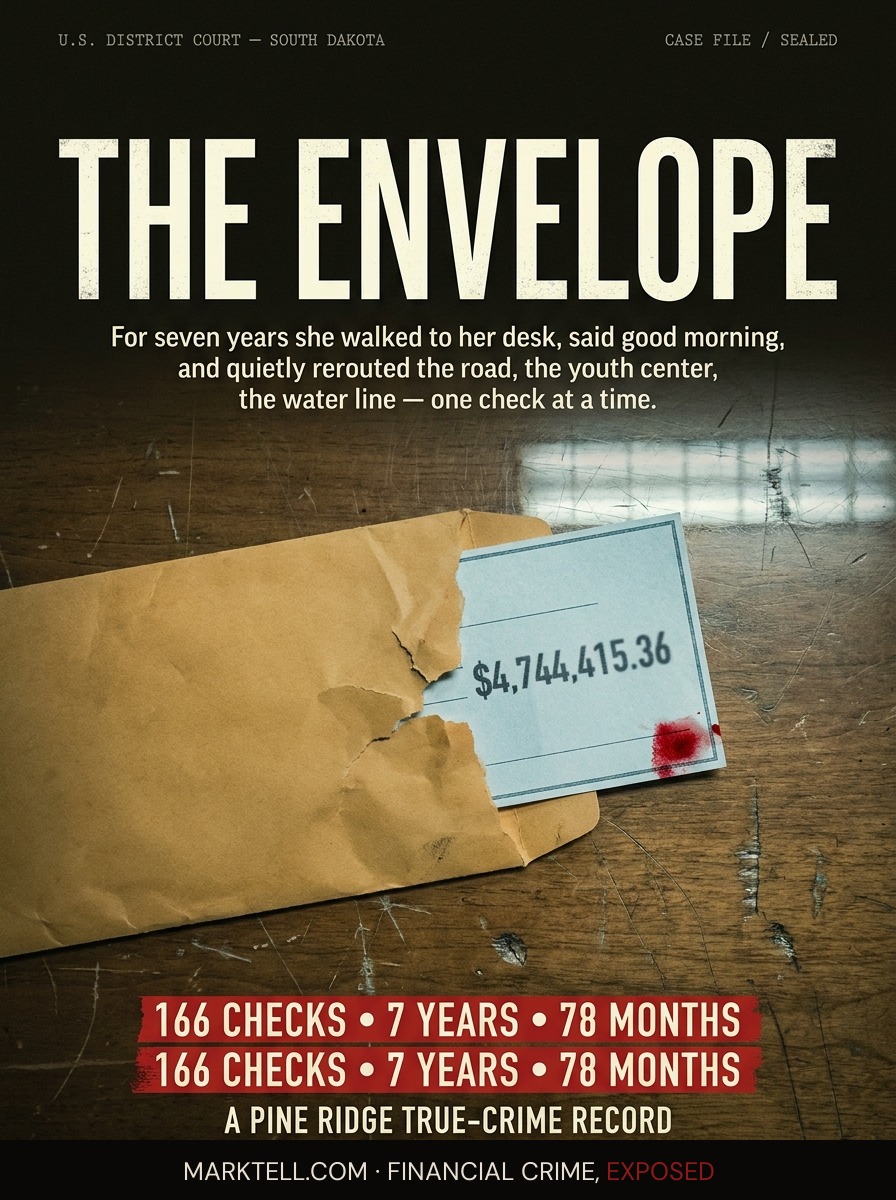
Between November 2017 and May 2024, according to the Department of Justice, she did not walk them down the hall. She routed them, 166 of them, into a personal bank account belonging to Patrick Ross. Ross is a citizen of the Oglala Sioux Tribe. He lives, or lived, in Porcupine.
The total was $4,744,415.36.
Read that number slowly. It has a decimal in it. That is not the number of a scheme that ran wild. That is the number of a scheme that kept books.
II.
There is a phrase for what Redfish sat behind. The check window. Not a physical window with a glass front and a sliding tray. A functional one. A place in an organizational chart where money moves from one hand to another, and only one person decides which hand.
Every fraud that runs for years runs through a check window. Someone approves the invoice. Someone signs the release. Someone walks the envelope down the hall. In small governments, in small nonprofits, in family-run companies, in tribal offices, the window is often one person wide. That is not a slur on small organizations. It is a description of how they staff.
The IRS has flagged this exact profile for years. Embezzlement from tribal enterprises. Kickback schemes where internal controls are thin. Not because tribal governments are uniquely vulnerable. Because organizations of that size, run with limited administrative overhead, tend to concentrate authority in the fewest possible seats.
One seat. One signature. One envelope.
The check window at Pine Ridge had a name on it, and the name was hers.
III.
Here is how the machine worked, according to Ross's guilty plea and the government's sentencing memorandum.
Contractor writes a check payable to TERO or to the tribe. Check arrives at the TERO office. Check reaches Redfish's desk. Instead of moving to the revenue department, the check is endorsed and deposited into Ross's personal account. Ross cashes it, banks it, uses it. Ross then pays a portion back to Redfish. Kickback.
Ross admitted to more than $2.1 million in kickbacks paid to Redfish across the run of the scheme. The rest stayed with him.
The money bought houses. The money bought vehicles. Federal investigators traced the specific purchases. That is what the money laundering counts are about, in plain English. Money laundering is not a movie word. It is the legal name for the act of taking dirty money and spending it in ways that make it look like clean money bought a car.
Buffy Redfish is fifty-seven, from Rushville, Nebraska, and a member of the Gila Tribe in Arizona. Patrick Ross is fifty-five. On June 29, 2026, in federal court, Judge sentenced Redfish to 78 months in federal prison and three years of supervised release. Full restitution ordered. Ross pleaded guilty and is scheduled for sentencing on August 24, 2026.
Do the math on the sentence. Seventy-eight months for $4.7 million and seven years of routing. That works out to a little over a month of prison for every $60,000 taken. I am not saying that is short. I am saying you should know the ratio.
IV.
Doreen does not know Buffy Redfish. She may not have known there was a TERO office in the sense of knowing the names of the people inside it. She knows there is a general fund. She knows there is not enough in it. She knows the youth center in her district has been a plan for as long as her grandkids have been alive.
The saddest math in this case is not the $4.7 million. It is what $4.7 million buys on Pine Ridge.
It buys the road. It buys the youth center. It buys the elder meal program for a stretch of years. It buys the water line to the house where the water line does not go. It buys some fraction of what a general fund is supposed to buy on a reservation where the general fund has never been enough.
The FBI Minneapolis Field Office worked the case with the Department of Health and Human Services Office of Inspector General. Special Agent in Charge Christopher D. Dotson said, in the press release announcing the sentencing, that those entrusted with public and tribal funds face significant prison sentences if they violate that trust.
That is the correct thing for him to say. It is also a thing that gets said every time one of these cases closes. It has been said in the Julian Bear Runner case, the former Oglala Sioux Tribe president convicted in 2024 of embezzling from the tribe. It will be said again.
The check window has a name on it. When one name comes off, another goes on.
V.
Here is what I want the reader to see.
The pump and dump gets the headlines. The crypto rug gets the headlines. The billion-dollar Ponzi with the yacht and the girlfriend gets the headlines. Those cases are real and they matter.
But the fraud that grinds down the places that can least afford to be ground down is not the headline fraud. It is the check-window fraud. It is one person in one seat routing one envelope the wrong way for seven years. It is $670,000 a year, on average, disappearing into a bank account across the state line. It is a road that does not get paved because the money that would have paved it bought a truck instead.
The predator in this story is not exotic. She was an employee. She walked to a desk every morning. She said good morning to people. She handled envelopes. She had a job description and she performed a version of it that looked, from any reasonable distance, exactly like the job.
That is the part the reader should sit with. Not the sentencing. Not the number. The seven years during which nothing looked wrong.
VI.
Doreen goes home from the community meeting in Kyle. It is cold. The heater in her truck works on one setting. She thinks about her cousin's road. She thinks about the youth center. She does not think about a woman in Rushville, Nebraska, because she has never heard the name.
The court has heard the name. The court has entered the judgment. The restitution order is $4,744,415.36, down to the thirty-six cents.
The thirty-six cents is what tells you the machine was careful. The road is what tells you the machine worked.
She just was not walking the envelope down the hall.
- U.S. Department of Justice, U.S. Attorney's Office for the District of South Dakota | June 29, 2026 | Sentencing announcement, United States v. Buffy Redfish
- Tribal Business News | July 13-14, 2026 | Former Oglala Sioux Tribe employee sentenced to 6½ years for $4.7 million TERO fraud
- FBI Minneapolis Field Office | June 2026 | Statement of SAC Christopher D. Dotson
- U.S. District Court for the District of South Dakota | 2026 | Indictment, plea agreement (Patrick Ross), and sentencing documents
- IRS | Ongoing guidance | Common financial risks to tribal governments, including embezzlement and kickback schemes
- Prior reporting | April 2024 | Conviction of former Oglala Sioux Tribe President Julian Bear Runner
Editorial Notice
MarkTell is a true crime publication about financial fraud. Some scenes, dialogue, and sequential details are reconstructed from court filings, enforcement actions, news reports, and public records. Where the public record does not provide exact details, editorial reconstruction is used to convey the documented pattern of events. Names of private individuals may be changed to protect identity. All factual claims are sourced to public documents cited in the Evidence Trail above. MarkTell does not provide investment, legal, or financial advice. Nothing published here constitutes a recommendation to buy, sell, or avoid any investment. Allegations described in active cases have not been adjudicated and defendants are presumed innocent until proven guilty. Readers should conduct their own due diligence before making financial decisions.