The bridge loans never existed. The bridge to Tbilisi did.
For three years a Victoria mortgage broker promised short-term real estate bridge loans paying returns no honest loan could carry. PricewaterhouseCoopers later found the loans were never there. On Friday, Greg Martel was arrested in the country of Georgia.
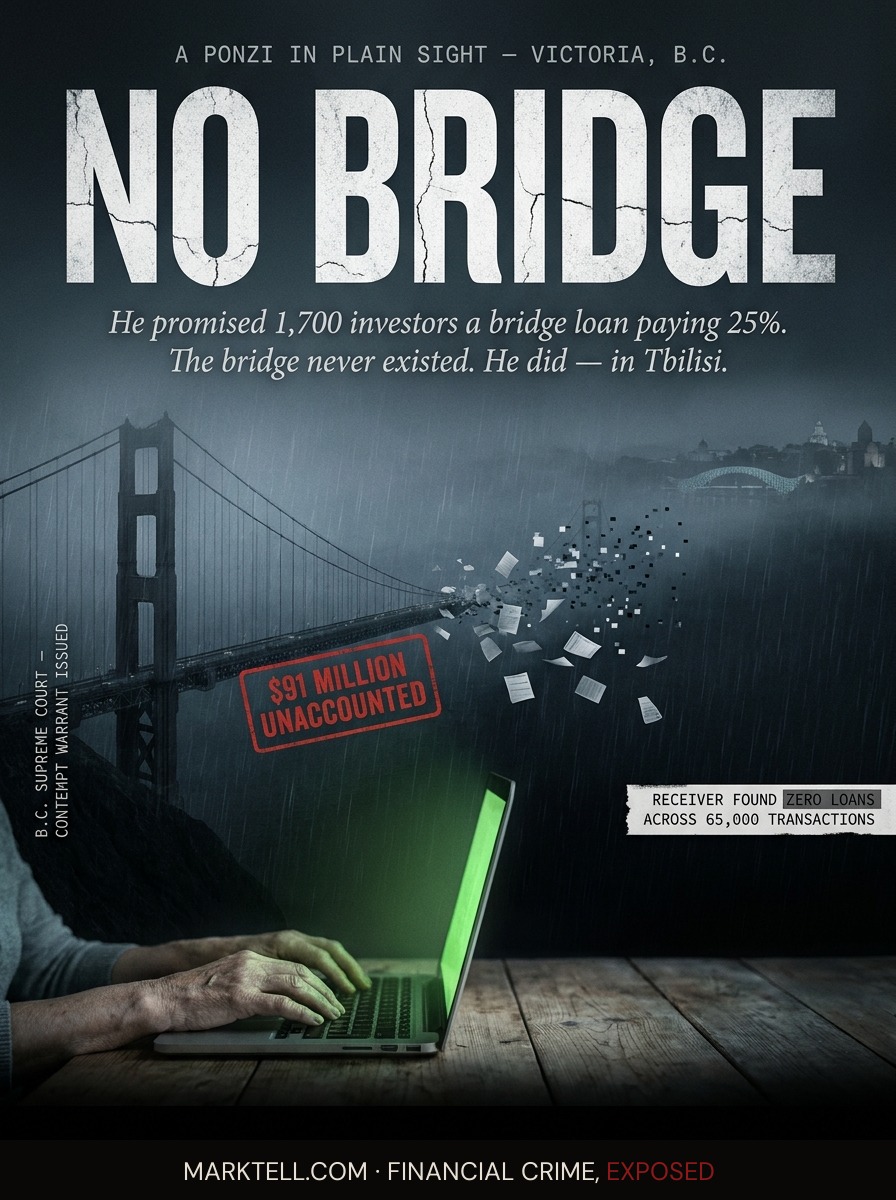
Margaret was sixty-eight and she was refreshing a browser tab.
The tab was a portal called Shop Your Own Mortgage. The portal showed her money in green numbers. The portal showed her a next payout date. In early 2023 that date began to move. First by a few days. Then by a week. Then by another week. She refreshed it on a laptop at her kitchen table in Saanich, the same table where her husband used to do the taxes before he died. The laptop was warm against her wrists. The number on the screen was $180,000. That part of the screen never moved. Only the date moved.
She had been told the money was in bridge loans. Short-term real estate loans, ten weeks, paying twenty-five percent. That was the promise sketched out for her at a coffee shop on Fort Street by a man who knew her cousin. The math worked out, he said, because the borrowers were desperate and short-term and over-collateralized. She did not know what over-collateralized meant. She wrote down the word.
She is one person. PricewaterhouseCoopers, the firm appointed as receiver, would later document about seventeen hundred of her.
I.
The man who built the portal was named Greg Martel. He ran a Victoria mortgage brokerage called My Mortgage Auction Corp. The brokerage did business as Shop Your Own Mortgage, abbreviated SYOM. From 2018 through the spring of 2023, according to the receiver, he raised approximately $301 million from roughly 1,700 investors. He paid approximately $210 million back out to those same investors as returns and redemptions.
That leaves $91 million.
The receiver, PricewaterhouseCoopers, did the work that should have been done by anyone who took the pitch seriously. PwC reviewed more than 65,000 banking transactions across 33 accounts. It traced the money. It looked for the bridge loans the money was supposed to fund.
There were no bridge loans.
Read that slowly. No bridge loans. Not bad bridge loans. Not delinquent bridge loans. Not loans that went into foreclosure. The category itself did not exist as a real thing inside the company. The portal showed loans. The statements showed loans. The pitch described loans. The forensic accountants, going account by account, found new investor money paying old investor money and a substantial tail of spending that had nothing to do with real estate.
The $91 million, according to filings in the B.C. Supreme Court bankruptcy proceedings, went to options trading losses, to other failing ventures including a car-sharing company called Carshair, and to Martel's personal lifestyle. Private jets. Luxury rentals. Vehicles. Jewelry.
That is the machine. A portal showing a bridge that was never built. Below the portal, a pipe taking new money in and pushing some of it back out as proof the bridge existed. Beside the pipe, a man living on the spillage.
II.
The pitch had to do real work, because the numbers were impossible.
Twenty-five percent over ten weeks annualizes to roughly one hundred thirty percent a year. Real estate bridge loans, even the aggressive, hard-money kind, do not earn that. Honest mortgage lenders in British Columbia in 2019, 2020, 2021 were not finding borrowers willing to pay one hundred thirty percent annualized for ten-week money. If they had been, the borrowers would have been on the edge of collapse, and the lender would have been writing off losses, not paying out steady weekly returns.
So the pitch had to do two things at once. It had to make the return sound credible. And it had to make the investor feel like an insider who had found a door other people had not found.
The door was a man at a coffee shop who knew your cousin.
The credibility came from the paperwork. SYOM produced subscription documents. It produced statements. It produced a working web portal that updated. It paid weekly, sometimes monthly, in real Canadian dollars wired to real bank accounts. For an investor like Margaret, the proof of the bridge was that the money kept arriving. She did not need to see the borrower. She saw the payout.
That is how Ponzi schemes feel from the inside. Not like fraud. Like a private opportunity that quietly works.
III.
In late 2022 the payouts began to stall.
This is the part of every Ponzi where the people running the machine make a series of decisions that, in retrospect, look like the machine deciding for itself. New money is slowing. Old money is asking for redemptions. The pipe runs dry in one direction before it runs dry in the other.
According to filings later compiled by PwC, between March and June 2023, 81 investors received what the receiver labeled "preference payments" totaling $3.12 million. Money pulled forward to specific people while other people's redemption requests sat unanswered.
Margaret's redemption request sat unanswered.
In May 2023 the B.C. Financial Services Authority suspended Martel and MMAC from acting as mortgage brokers. The company was placed into receivership. In June 2023, MMAC was assigned into bankruptcy. On August 31, 2023, the B.C. Supreme Court declared Greg Martel personally bankrupt.
In September 2023, Justice Shelley Fitzpatrick found Martel in contempt of court for refusing to cooperate with the receiver. A warrant was issued for his arrest in Canada.
He was already gone. Reports placed him in Thailand. Then Dubai. Then silence.
IV.
The receiver kept working.
PwC's job in a collapse like this is unglamorous and slow. Trace the money. Identify who got what. Decide who has to give it back. The firm's fees in the MMAC matter have run to more than $12 million, with about $6 million outstanding as of September 2025 per receiver reports. The fees come out of recovery. The recovery comes from the investors who got more than they put in.
This is the part that may be the saddest.
Of the 1,709 investors, the receiver categorized 480 as "winners." They had received $68.25 million more than they put in. They were not the people running the scheme. Some of them were retirees who happened to enter early, take their weekly payouts, and exit when the math told them to. Some of them are now being sued by the trustee to give that money back.
The other 1,229 are "losers." They put in $149 million more than they got out. Margaret is one of them. Her $180,000 went in. A few months of payouts came out. The portal kept refreshing until it stopped.
In a landmark ruling, Justice Fitzpatrick approved the clawback of approximately $71 million from winners and preference recipients to redistribute more equitably across all victims. The reasoning, in the court's words, was that no one is entitled to keep false profits.
False profits. That is the renaming. The weekly payouts were not interest. They were not returns. They were redistributions of other people's money the recipient did not know had been stolen. The court was naming them what they had always been.
V.
On Friday, June 5, 2026, Greg Martel was arrested in the country of Georgia.
Not the U.S. state. The country. Capital city Tbilisi. A place with selective extradition relationships and a long history of being a soft landing for people the rest of the world wants to talk to.
Global Affairs Canada confirmed the arrest of a Canadian citizen in Georgia and said it was providing consular assistance. The specific circumstances of the arrest, what tipped the local authorities, who was working the file, have not been made public as of this writing. There are no criminal charges in Canada. There is a contempt warrant from the B.C. Supreme Court. There is a BCFSA criminal investigation that has been ongoing since 2023. There is a long road between an arrest in Tbilisi and a courtroom in Vancouver.
Allegation is not adjudication. The receiver's findings, however, have been accepted by the court. The bridge loans did not exist. The math was never math.
VI.
Margaret keeps the laptop closed now. The portal is gone. The web address redirects to a receiver's notice.
She still gets letters. Some of them are from PwC about the bankruptcy estate and the expected timeline for any partial distribution. Some are from lawyers in the class action against RBC and the BCFSA, which alleges, and only alleges, that the bank and the regulator missed signals they should have caught. Those cases are unresolved.
What Margaret lost is not only the $180,000. She introduced two friends from her church to SYOM. Both of them invested. One of them has not spoken to her since 2023. The other calls on her birthday.
Picture it. A kitchen table in Saanich. A closed laptop. A woman who was told there was a bridge.
There was no bridge. There was a man, and a pipe, and a portal, and a country far enough away to disappear into for three years.
This week the bridge to Tbilisi closed too.
- CBC News | June 6, 2026 | "B.C. Ponzi schemer Greg Martel arrested in Georgia"
- PricewaterhouseCoopers Inc., Receiver Reports re My Mortgage Auction Corp. | 2023-2025 | B.C. Supreme Court receivership filings
- B.C. Supreme Court | Aug 31, 2023 | Order declaring Greg Martel personally bankrupt
- B.C. Supreme Court, Justice Shelley Fitzpatrick | Sept 2023 | Contempt finding and arrest warrant
- B.C. Supreme Court, Justice Shelley Fitzpatrick | Clawback ruling approving recovery of false profits from net winners
- B.C. Financial Services Authority (BCFSA) | May 2023 | Suspension of Martel and MMAC as mortgage brokers
- Global Affairs Canada | June 2026 | Confirmation of arrest of Canadian citizen in Georgia
- Class action filings against RBC and BCFSA | filed in B.C. courts | ongoing
Editorial Notice
MarkTell is a true crime publication about financial fraud. Some scenes, dialogue, and sequential details are reconstructed from court filings, enforcement actions, news reports, and public records. Where the public record does not provide exact details, editorial reconstruction is used to convey the documented pattern of events. Names of private individuals may be changed to protect identity. All factual claims are sourced to public documents cited in the Evidence Trail above. MarkTell does not provide investment, legal, or financial advice. Nothing published here constitutes a recommendation to buy, sell, or avoid any investment. Allegations described in active cases have not been adjudicated and defendants are presumed innocent until proven guilty. Readers should conduct their own due diligence before making financial decisions.