The bonus pool was a stock that did not exist. The sale was a ghost. The conspiracy was real.
Aaron Zahn engineered a bonus plan that could have paid him $40 million if Jacksonville sold its public utility. The sale died. The bonuses never paid. His lawyers told a federal appeals court this week that means nothing was stolen. The judges did not seem persuaded.
Delores is seventy-one. She has lived in the same Northside house since 1984, and the JEA bill has come to that address every month of every one of those years. The bill has gone up. Her income has not. She keeps the bills in a manila folder in a drawer in the kitchen, because she was raised by people who kept everything.
In the summer of 2019, her neighbor across the street, a retired schoolteacher named Yvonne, knocked on her door and told her to watch a meeting on her tablet. Yvonne said the city was thinking about selling the electric company. Delores did not know the city owned the electric company. She had paid it for thirty-five years and never once thought about who she was paying.
She watched the meeting on her porch. Men in suits. A long table. A vote. She did not understand what she was looking at.
What she was looking at was a trapdoor being cut into the floor.
I.
JEA is the public utility for Jacksonville, Florida. It is owned by the city. That means it is owned by Delores, and by Yvonne, and by every other person who pays a bill or votes in a municipal election. It carries about $3.6 billion in outstanding electric and water revenue bonds. It is one of the largest things the city owns.
In 2018, Mayor Lenny Curry's administration began exploring a sale. Aaron Zahn became interim CEO of JEA in April of that year. He had no utility experience. He had run a wastewater startup. He was thirty-eight.
The pitch to the public was a story called the death spiral. Zahn and his leadership said JEA was headed for ruin. Twenty-nine percent of the workforce would have to be cut. Electric rates would rise twenty-six percent. The utility could not survive as a public asset. It had to be sold.
JEA's own analysts said this was not true. One of them, a man named Tim Hunt, testified later that the numbers had no support. The death spiral was a story told to make a sale feel necessary.
The sale was the door. The story was the lock.
II.
On July 23, 2019, the JEA board approved two things in the same meeting. The first was an Invitation to Negotiate, which is the formal document that lets buyers bid. The second was the Performance Unit Plan.
The Performance Unit Plan is the thing the federal case is about. Read it slowly.
A "performance unit" was a kind of paper share. It was tethered to JEA. But JEA had no stock, because public utilities owned by cities do not have stock. Cities are not corporations. There is nothing to own a share of. The performance unit was a made-up instrument in a made-up category, attached to a public entity that had no equity to attach to.
Each unit started at a value of ten dollars. If JEA was sold, each unit could rise to as much as $11,500. Senior executives would hold the units. Aaron Zahn would hold a lot of them.
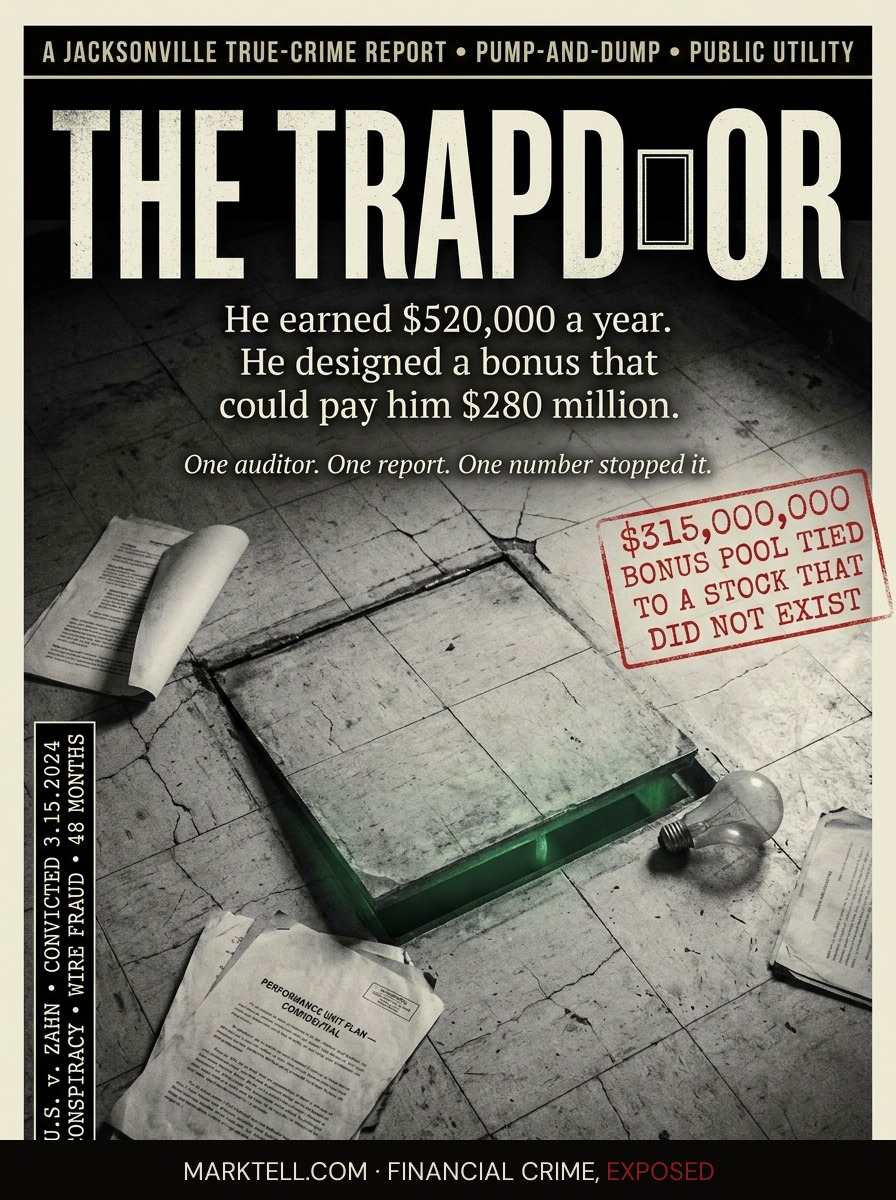
According to the Council Auditor's November 2019 report, the plan could have produced payouts to senior executives exceeding $600 million. Prosecutors put the figure at a potential bonus pool of $315 million, with Zahn personally expecting to receive approximately $40 million. Zahn himself, according to trial evidence, had estimated his payout at around $280 million if JEA sold for $2 to $3 billion.
His actual annual salary was $520,000.
Picture the math. A man earning half a million a year designed a side instrument that could pay him eighty times his salary in a single transaction, in a transaction he was running, involving an asset he did not own.
That is the trapdoor.
III.
Delores did not watch the July 23 meeting. She watched the one a few months later, after Yvonne knocked. By then the Council Auditor had published the report. The number $600 million was on a public document. The newspapers had printed it. People were calling their council members.
She read the number on her tablet. She did not understand what a performance unit was. She did not need to. She understood that men who worked for her electric company were going to be paid more money than she could imagine if her electric company was sold to someone else.
She thought about the porch light. She thought about how her granddaughter had learned to read sitting under it. She thought about the bills in the drawer.
On December 24, 2019, the JEA board canceled the sale process. On January 28, 2020, Aaron Zahn was fired with cause. Being fired with cause meant he did not collect the $842,925 severance package his contract entitled him to if fired without cause. He got nothing.
In June 2020, JEA filed a civil suit calling him the principal architect and ringleader of perhaps the largest fraud in Jacksonville history. That is JEA's language, in JEA's filing.
On March 2, 2022, a federal grand jury indicted Zahn and former CFO Ryan Wannemacher on conspiracy and wire fraud charges.
On March 15, 2024, Zahn was convicted of conspiracy to embezzle federal property and wire fraud. Wannemacher was acquitted by a separate jury.
On July 30, 2024, Zahn was sentenced to four years. He is now at FCI Edgefield, a low-security federal prison in South Carolina.
IV.
Which brings us to last Tuesday.
On June 23, 2026, a three-judge panel of the 11th U.S. Circuit Court of Appeals heard oral arguments in Jacksonville on Zahn's appeal. His attorneys have built two arguments.
The first is the property never existed defense. They argue that because the JEA sale never closed, the bonus pool never came into being, and therefore no property was taken. You cannot steal a thing that does not exist.
This is an elegant argument. It is also an old one. Federal conspiracy law has, for decades, held that the crime is the agreement and the steps taken in furtherance of it. The bank robber who plans the robbery and drives to the bank and then loses his nerve in the parking lot has still committed a conspiracy. The question is not whether the money moved. The question is whether the agreement to take it was made.
The second argument is narrower. The wire fraud conviction rests in part on a JEA board meeting that was automatically live-streamed. Zahn's attorneys say he did not control the stream, did not press the button, did not cause the wire. The defense is that the wire was incidental.
The panel, according to reporting from the hearing, did not appear persuaded by either argument.
But the appeal is not yet decided. Allegation is one thing. Adjudication is another. Appeal is a third. We will know when we know.
V.
Here is the part nobody wants to say out loud.
The trapdoor was cut into the floor of a public building. The people who paid for the floor did not know there was a door in it. The people standing on the door knew. The plan was for the door to open during the sale, the money to fall through, and the floor to be replaced before anyone noticed.
The plan failed because one auditor wrote a report. That is the whole story of why Delores still owns her electric company. One auditor. One report. One number on a public document in November 2019.
Without that report, the sale moves forward. Without that report, NextEra Energy submits its reported $11 billion offer. Without that report, the performance units convert. Without that report, $40 million lands in Aaron Zahn's account on a Tuesday and nobody outside the boardroom understands what happened until years later, if ever.
That part may be the saddest. Not that the fraud was attempted. That the only thing standing between Delores and a stranger owning her porch light was a single municipal employee doing arithmetic.
VI.
Delores still pays her bill. The bill still comes to the same address. The folder in the drawer is fatter now. She does not watch board meetings anymore. Yvonne moved to Georgia to live with her son.
The appeal will be decided in the coming months. If the 11th Circuit affirms, Zahn finishes his sentence at FCI Edgefield. If they reverse, the case goes back. If they order a new trial, Jacksonville gets to watch it all again.
The trapdoor was closed. The hinges are still in the floor.
He thought he was selling a utility. He was selling the floor he was standing on.
- The Florida Times-Union | June 24, 2026 | "Lawyers revisit JEA ex-CEO Aaron Zahn's guilt in Jacksonville appeal"
- U.S. District Court, Middle District of Florida | March 15, 2024 | United States v. Aaron Zahn, verdict
- U.S. District Court, Middle District of Florida | July 30, 2024 | United States v. Aaron Zahn, sentencing
- U.S. District Court, Middle District of Florida | March 2, 2022 | Indictment of Zahn and Wannemacher
- Jacksonville City Council Auditor | November 18, 2019 | Report on JEA Performance Unit Plan
- JEA Board of Directors | July 23, 2019 | Board meeting minutes, ITN and PUP authorization
- JEA v. Zahn et al. | June 2020 | Civil complaint, Duval County
- 11th U.S. Circuit Court of Appeals | June 23, 2026 | Oral argument, United States v. Zahn
- Federal Bureau of Prisons | inmate locator, FCI Edgefield
Editorial Notice
MarkTell is a true crime publication about financial fraud. Some scenes, dialogue, and sequential details are reconstructed from court filings, enforcement actions, news reports, and public records. Where the public record does not provide exact details, editorial reconstruction is used to convey the documented pattern of events. Names of private individuals may be changed to protect identity. All factual claims are sourced to public documents cited in the Evidence Trail above. MarkTell does not provide investment, legal, or financial advice. Nothing published here constitutes a recommendation to buy, sell, or avoid any investment. Allegations described in active cases have not been adjudicated and defendants are presumed innocent until proven guilty. Readers should conduct their own due diligence before making financial decisions.