The badge was still warm. The trust was already spent.
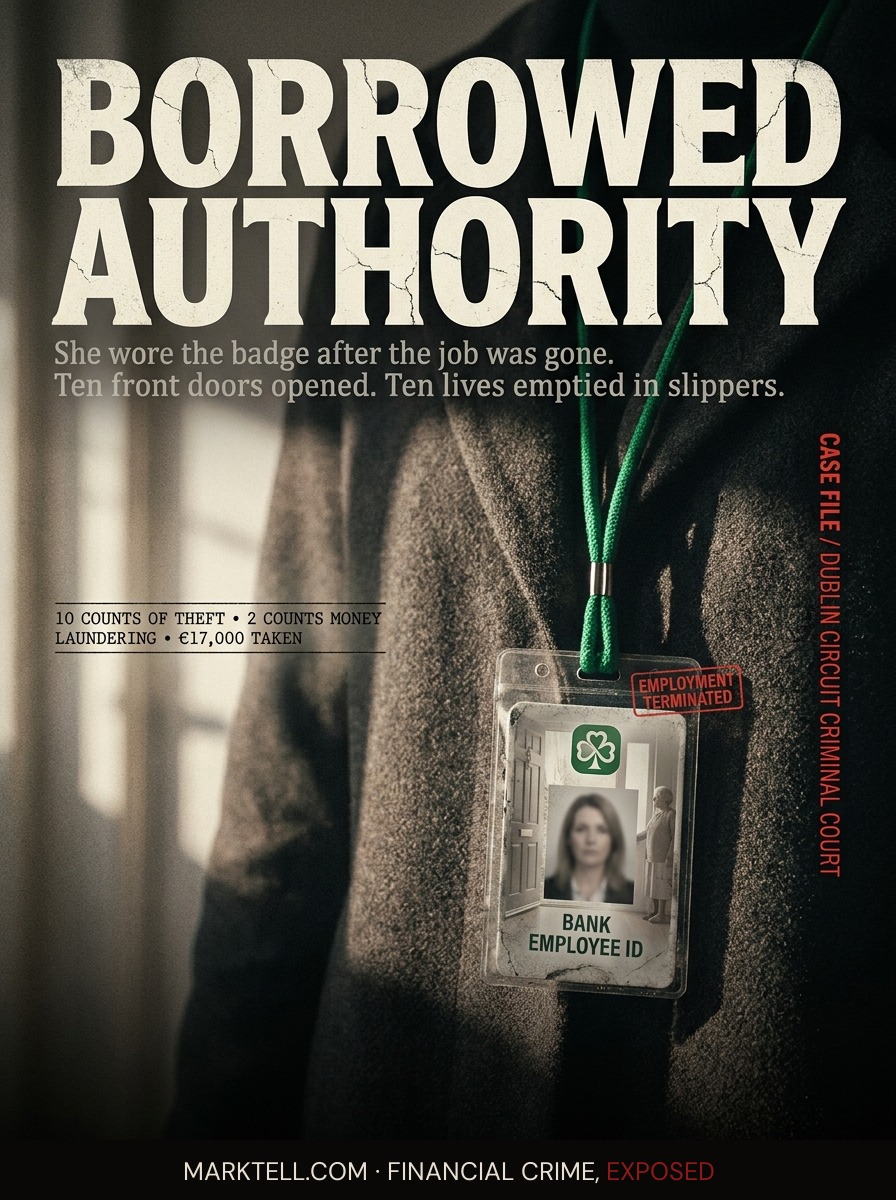
Joelle Mopiti, 27, pleaded guilty to ten counts of theft and two counts of money laundering after using a bank staff badge to collect cards from AIB customers. The badge did most of the work.
Margaret was seventy-one and she kept her bank statements in a biscuit tin on the kitchen counter. Not because she was old-fashioned. Because her sister had been done for a few hundred euro the year before by a phone call about a parcel, and Margaret had decided that paper was safer than pixels. The tin had a picture of Rowntree's fruit pastilles on the lid. The statements inside were AIB.
The doorbell rang on a Tuesday afternoon. Margaret was making tea.
The woman on the step had a lanyard. Green cord. A card in a plastic sleeve. The card had the AIB logo and a photograph and a name Margaret did not catch because she was looking at the logo. The woman said there was a problem. Something about a card, something about fraud on the account, something about needing to take the card in for the branch to check. Margaret thought about the biscuit tin and about her sister and about the fact that a bank employee was standing on her step in the middle of the afternoon looking her in the eye.
She went inside. She got the card. She handed it over.
That is the scene. That is the machine.
I. THE BADGE
Joelle Mopiti is twenty-seven and lives on Brookview Avenue in Tallaght. She used to work at AIB. The past tense matters. When she went to the doors, she was not an employee. She was a former employee wearing an employee's badge.
She has pleaded guilty at Dublin Circuit Criminal Court to ten counts of theft and two counts of money laundering. Sentencing is set for later in July. The take, according to the charges: more than €17,000 (about $18K USD). Spread across ten victims. An average of roughly €1,700 (about $1,800 USD) per doorstep.
Read that number slowly. Not because it is enormous. Because it is small. Small enough that any single victim, taken alone, would look like an accident. Ten of them together is not an accident. Ten of them together is a route.
The badge is the whole story. Not the theft. Not the laundering. The badge.
II. WHAT THE BADGE DID
A bank staff badge is a piece of laminated plastic on a lanyard. In the bank branch, it means almost nothing. Everyone has one. It gets you through a door you would have walked through anyway.
On a doorstep, it means everything.
It means the person in front of you has been vetted, background-checked, trained in the correct procedures, sworn to a code. It means the institution behind them is standing behind them. It means the words "there is a problem with your card" carry the weight of a hundred and ninety years of Irish banking, not the weight of a stranger's mouth.
That is what the badge is. It is not identification. It is authority, borrowed and worn.
When the employment ends, the authority is supposed to end with it. The badge is supposed to come back. The lock is supposed to be changed.
The complaint here, in effect, is that the lock was not changed. Or the badge was not returned. Or nobody checked. Something in that chain broke, and the piece of laminated plastic kept opening doors after the person carrying it had no right to be there.
III. THE ROUTE
Picture the route. This is reconstruction, grounded in the charged conduct.
A woman walks up a garden path in a suburb where the residents are older, the doors are on the street, the porch lights come on at four. She is wearing the lanyard on the outside of her coat where it can be seen. She rings the bell. She uses the language a bank employee would use. Card. Branch. Fraud. Check. The customer, standing in the hallway in slippers, hears the correct words in the correct order and does the thing the correct words are asking for.
She hands over the card.
Somewhere in the exchange, the PIN gets given up too. Maybe she is told there is a form. Maybe she is told the branch needs to verify. The record does not say exactly how the PIN moved from the customer's memory to the operator's hand. It says only that the money moved after.
Then the woman walks back down the path.
Then the ATM. Then the transfer. Then the biscuit tin, or whatever the customer used, becomes a record of what used to be there.
IV. THE CONTEXT
This is not a one-off. Read this next number the same way you read the first one.
Insider fraud in Irish companies rose almost four hundred percent between 2023 and 2024, reaching close to €10 million (about $11M USD). That is according to the reporting compiled around the Central Bank of Ireland's research published in April 2026. The same research found that thirty-five percent of Irish adults have experienced fraud or scams. Reported payment fraud losses in Ireland in 2024: €160 million (about $170M USD). Up twenty-four and a half percent from the year before.
AIB itself, in late June 2026, warned that fake AIB investment sites had exploded. Between January and May 2026, the bank filed one thousand five hundred times more takedown requests for fake domains than in all of 2025. Harold Perez, AIB's Head of Fraud Intelligence, has said the tactics are getting more sophisticated. Carol Lawton, AIB's Head of Financial Crime, has said investment scams often use the real names and real job titles of real bank staff.
The Mopiti case is the physical version of that. Not a cloned website. Not a spoofed email address. A cloned employee. Same logo. Same lanyard. Same script. Different intent.
V. MARGARET, THE MORNING AFTER
Margaret went to the ATM the next morning because she wanted to check.
The screen showed a balance she did not recognise. She stood there with her hand on the machine and looked at the number and did the arithmetic that seventy-one-year-olds do when a number is wrong, which is to look for the mistake in themselves first. Had she taken money out and forgotten. Had she paid a bill twice. Had she given the grandkids more than she remembered.
Then she thought about the woman at the door.
Then she thought about the lanyard.
Then she went home and sat at the kitchen table with the biscuit tin open and did not touch the statements inside because she did not want to know yet.
That part may be the saddest. Not the money. The sitting.
VI. THE MACHINE UNDER THE BADGE
Every good scam borrows an authority it did not earn. The Mopiti case is unusually clean about this because the borrowing is literal. A physical badge. A physical lanyard. A physical uniform of trust, worn on the outside of a coat, on a garden path, in the middle of the afternoon.
The renaming is this. The badge was not identification. The badge was a key.
A key that was supposed to be handed back on the last day of employment. A key that, according to the guilty plea now on record, was used ten times to open ten front doors and take what was behind them.
Sentencing comes later this month. The number in the record is more than €17,000 (about $18K USD). The number that is not in the record is the number of people who, after reading about this case, will look at the next lanyard on the next doorstep and hesitate.
That hesitation is the only piece of the story that is worth anything to anyone still standing in a hallway with a card in their hand.
The badge was still warm. The trust was already spent.
- Sunday World | July 2026 | "Former AIB employee wore staff badge to swindle customers in €17k organised scam"
- AML Intelligence | July 2, 2026 | Reporting on the Joelle Mopiti case
- Central Bank of Ireland | April 29, 2026 | Research on fraud prevalence in Ireland (35% of adults affected, €160M in 2024 payment fraud losses)
- AIB Fraud & Security Centre | June 26, 2026 | Warning on fake investment sites; statements from Harold Perez, Head of Fraud Intelligence
- AIB / Carol Lawton, Head of Financial Crime | Public statements on investment scam sophistication
- Irish Examiner | June 27, 2026 | Reporting on Irish investment scam losses referencing AIB fraud trend update
- Dublin Circuit Criminal Court | 2026 | Guilty plea, ten counts of theft, two counts of money laundering; sentencing scheduled July 2026
Editorial Notice
MarkTell is a true crime publication about financial fraud. Some scenes, dialogue, and sequential details are reconstructed from court filings, enforcement actions, news reports, and public records. Where the public record does not provide exact details, editorial reconstruction is used to convey the documented pattern of events. Names of private individuals may be changed to protect identity. All factual claims are sourced to public documents cited in the Evidence Trail above. MarkTell does not provide investment, legal, or financial advice. Nothing published here constitutes a recommendation to buy, sell, or avoid any investment. Allegations described in active cases have not been adjudicated and defendants are presumed innocent until proven guilty. Readers should conduct their own due diligence before making financial decisions.