Medicare paid the invoices. The patients did not exist.
Federal prosecutors say Ibrahim Khaldoon Hilmi ran a network of shell companies that billed Medicare for medical equipment never ordered and patients who never existed. He fled to Türkiye in May 2025. On June 19, 2026, two FBI agents walked him onto a plane.
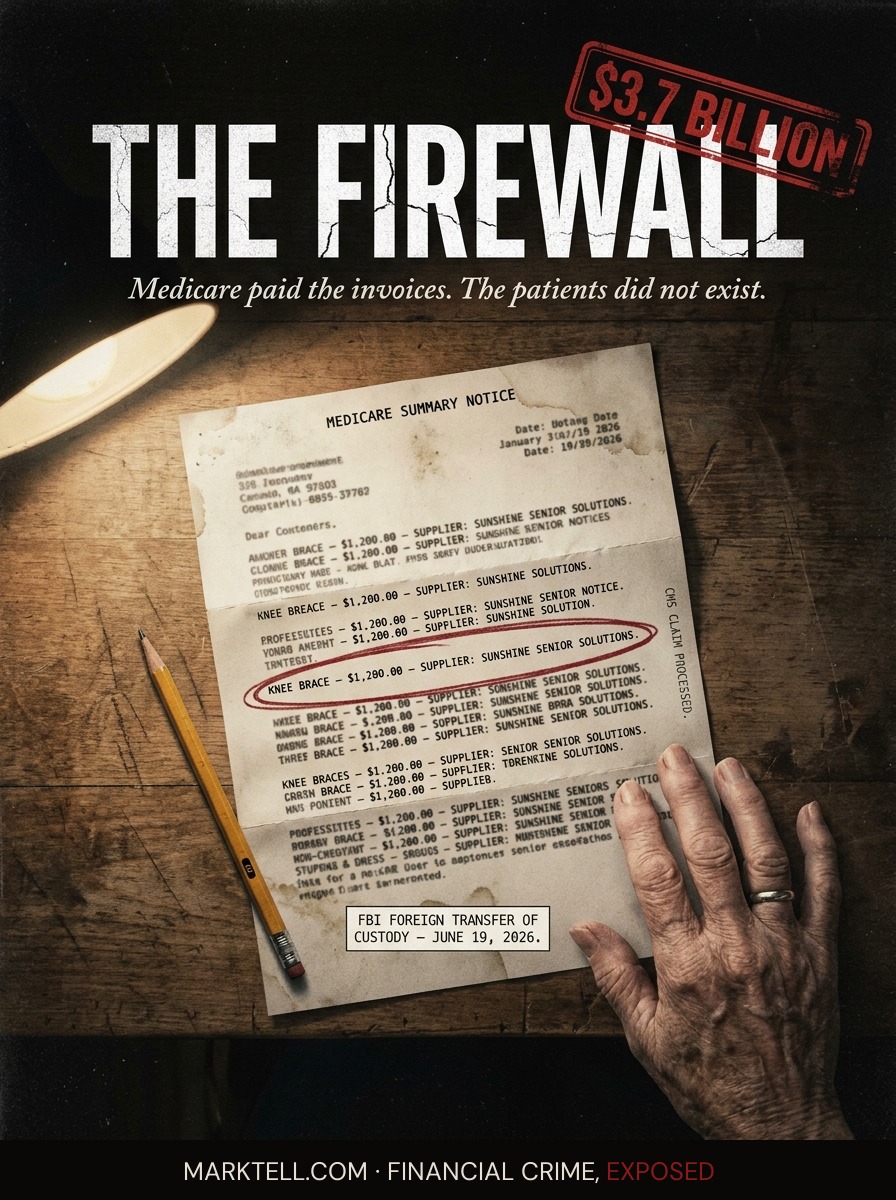
Ellen is seventy-one. She lives in a single-story house off a county road north of Ocala. On the first of every month she sits at the kitchen table with a sharpened pencil and opens an envelope from Medicare. The document inside is called a Medicare Summary Notice. It lists every claim filed against her account in the previous month. Doctor visits. Lab work. Equipment.
She reads it the way she used to read the card catalog at the elementary school where she worked for thirty-one years. Line by line. She is not looking for trouble. She is looking for accuracy.
In April she found a line for a knee brace. The brace was billed to a supplier she did not recognize. The date of service was a Tuesday in March. On that Tuesday she had been at her daughter's house in Gainesville, helping with a grandchild who had the flu. She had not ordered a knee brace. She did not have a knee problem. No knee brace had ever arrived at her house.
She put the pencil down. She picked up the Medicare card from the drawer next to the silverware and looked at the number on it the way a person looks at a key they thought only they had.
This is the story of a key that the government says somebody else had a copy of. Many somebodies. For a long time.
I.
According to the U.S. Department of Justice, Ibrahim Khaldoon Hilmi is a Florida-based businessman who orchestrated a Medicare fraud scheme that billed the federal government for approximately $3.7 billion. The mechanism, as alleged, is one the FBI and the Department of Health and Human Services Office of Inspector General have seen before. Shell companies. Durable medical equipment. Claims for catheters and braces and supplies that were never ordered, never delivered, or billed against patients who did not exist.
One of the shells named in the public record is called Sunshine Senior Solutions. The name is doing work. It sounds like a community service. It sounds like the kind of company a daughter would recommend to her mother.
The way these schemes operate, on the public record from prior DOJ prosecutions, is mechanical. An operator obtains lists of Medicare beneficiary numbers. Those numbers are the key. With the number and a prescriber identity, a claim can be submitted to the Centers for Medicare and Medicaid Services. CMS pays. The supplier is supposed to deliver the equipment to the patient. In a fraud, the supplier delivers nothing. The money lands. The patient, if they catch it at all, catches it on a statement like the one Ellen opened in April.
The federal indictment says the operation spread its claims across dozens of business fronts. That is the design. A single storefront billing a billion dollars to Medicare is a flag. Forty storefronts each billing a fraction of that figure is camouflage. The auditing systems at CMS look for outliers. The scheme, as alleged, was built to not be an outlier in any one place.
That is the machine. One operator. Many storefronts. One pipe to the Treasury.
II.
Hilmi disappeared in May 2025.
The federal investigation had been moving toward him. He left the country. The destination was Türkiye. The reason he chose Türkiye and the route he took to get there are details the public record does not yet contain.
What the public record does contain is this. On June 19, 2026, Hilmi was handed over to FBI custody by Turkish authorities in what the Bureau called a Foreign Transfer of Custody operation. FBI Miami and the Critical Incident Response Group ran the transfer. U.S. Ambassador to Türkiye Tom Barrack was credited for the diplomatic work. FBI Director Kash Patel said publicly that fraudsters will be pursued "no matter where they hide." Vice President JD Vance, who chairs the White House task force on healthcare fraud, said there will be "no safe harbor."
This is the part of the story that gets the press release. The extradition. The handcuffs. The plane.
The other part of the story is Ellen at the kitchen table in April, holding the pencil, looking at the line item for the knee brace.
III.
Picture the pipe.
On one end is the Treasury. On the other end is a storefront in a strip mall, or a P.O. box, or a website with a stock photo of a smiling older woman in a cardigan. In between is the Medicare claims system, which processes millions of claims a day and which was built on the assumption that providers are who they say they are and that equipment billed is equipment delivered.
The fraud lives in that assumption.
A legitimate durable medical equipment supplier serves real patients with real prescriptions and ships real boxes. The fraudulent supplier, as alleged in cases like this one, serves a database. The database has names and numbers in it. The names sometimes belong to living Medicare beneficiaries who never ordered anything. Sometimes the names belong to people who have died. Sometimes the names do not belong to anyone at all. The system does not know the difference at the moment of payment. The system finds out later, if it finds out.
The estimates of total annual Medicare fraud range from $60 billion at the low end to over $100 billion at the high end. Some analysts put the figure higher than that. These are not small numbers stacked into a big number. They are the cost of a system that has to pay claims quickly enough to keep medical care moving and that cannot, at the moment of payment, verify every storefront and every box.
The fraud is the gap between the speed the system needs and the verification the system can afford.
IV.
Ellen called the number on the back of her card. She spent forty minutes on hold and then twenty minutes with a representative who took the information and opened a report. The representative told her she had done the right thing. Most people, the representative said, do not read the Summary Notice.
That part may be the saddest. The system relies on the patient to be the last line of audit. The patient is seventy-one, has cataracts, and may not have gone to college. The patient is the firewall.
Ellen is composite. The line item is not. The DOJ has prosecuted hundreds of cases like this. The shape repeats. The names of the storefronts change. The product changes. Catheters one year. Knee braces another. Genetic testing kits another. The pipe is the same pipe.
After the call, Ellen put the Summary Notice in a folder she labeled "Medicare." The folder is in the top drawer of the kitchen desk. She does not know if she is in the Hilmi case. She probably is not. The Hilmi case, as alleged, involves so many beneficiary numbers that a single patient is a grain in a beach. But the system Ellen described, the storefront billing for equipment she never received, is the system the indictment describes. She is in some version of the case. Many people are.
V.
The press release gets the language of victory. The extradition gets the photograph. The Vice President gets the quote.
The Summary Notice gets the kitchen table.
Hilmi's lawyers have not yet filed a substantive response in the public docket. The charges are charges. Allegation is not adjudication. He will have a trial or a plea, and at the end of either one a number will be entered into the record. The number may be close to $3.7 billion. It may be smaller. The recovered amount, on past cases of this scale, will be a fraction of the billed amount. The Treasury rarely gets whole.
What Ellen lost is not the knee brace. She did not need the knee brace. She did not pay for the knee brace. CMS paid for the knee brace.
What she lost is the feeling that the card in the drawer is hers alone.
VI.
Two fugitives in less than a week. Hilmi from Türkiye on June 19. Herbert Kimble, accused in a separate $1.3 billion scheme, from the Philippines between June 18 and June 20. Together, on the government's numbers, about $5 billion in alleged theft from American taxpayers walked back into U.S. custody in seven days.
The FBI has launched a "Most Wanted Fraudsters" list. Three arrests in two weeks. The operational tempo is up. The press is good.
Read this slowly. The arrests are the end of one cycle of one machine. The machine is bigger than any one operator. The shell companies dissolve. New ones incorporate. The beneficiary numbers keep getting harvested. The storefronts keep getting addresses. The Summary Notice keeps arriving on the first of the month.
Ellen will open the one for May at the kitchen table with the pencil in her hand. She will read it line by line. She is the firewall. She did not ask to be.
That is the part nobody puts on the press release.
- Hürriyet Daily News | June 2026 | "US fugitive accused in $3.7 bln Medicare fraud extradited from Türkiye"
- U.S. Department of Justice | June 2026 | Public statements on Hilmi extradition and Operation Gold Rush
- FBI | June 19, 2026 | Statements by Director Kash Patel on Foreign Transfer of Custody operation
- White House | 2026 | Statements by Vice President JD Vance on healthcare fraud task force
- HHS Office of Inspector General | Ongoing | Joint investigation with FBI on durable medical equipment fraud cases
- DOJ | 2025 | National Health Care Fraud Takedown summary, $14.6 billion in alleged fraud
- CMS | Public data | Annual Medicare fraud loss estimates ($60B to $100B+)
Editorial Notice
MarkTell is a true crime publication about financial fraud. Some scenes, dialogue, and sequential details are reconstructed from court filings, enforcement actions, news reports, and public records. Where the public record does not provide exact details, editorial reconstruction is used to convey the documented pattern of events. Names of private individuals may be changed to protect identity. All factual claims are sourced to public documents cited in the Evidence Trail above. MarkTell does not provide investment, legal, or financial advice. Nothing published here constitutes a recommendation to buy, sell, or avoid any investment. Allegations described in active cases have not been adjudicated and defendants are presumed innocent until proven guilty. Readers should conduct their own due diligence before making financial decisions.