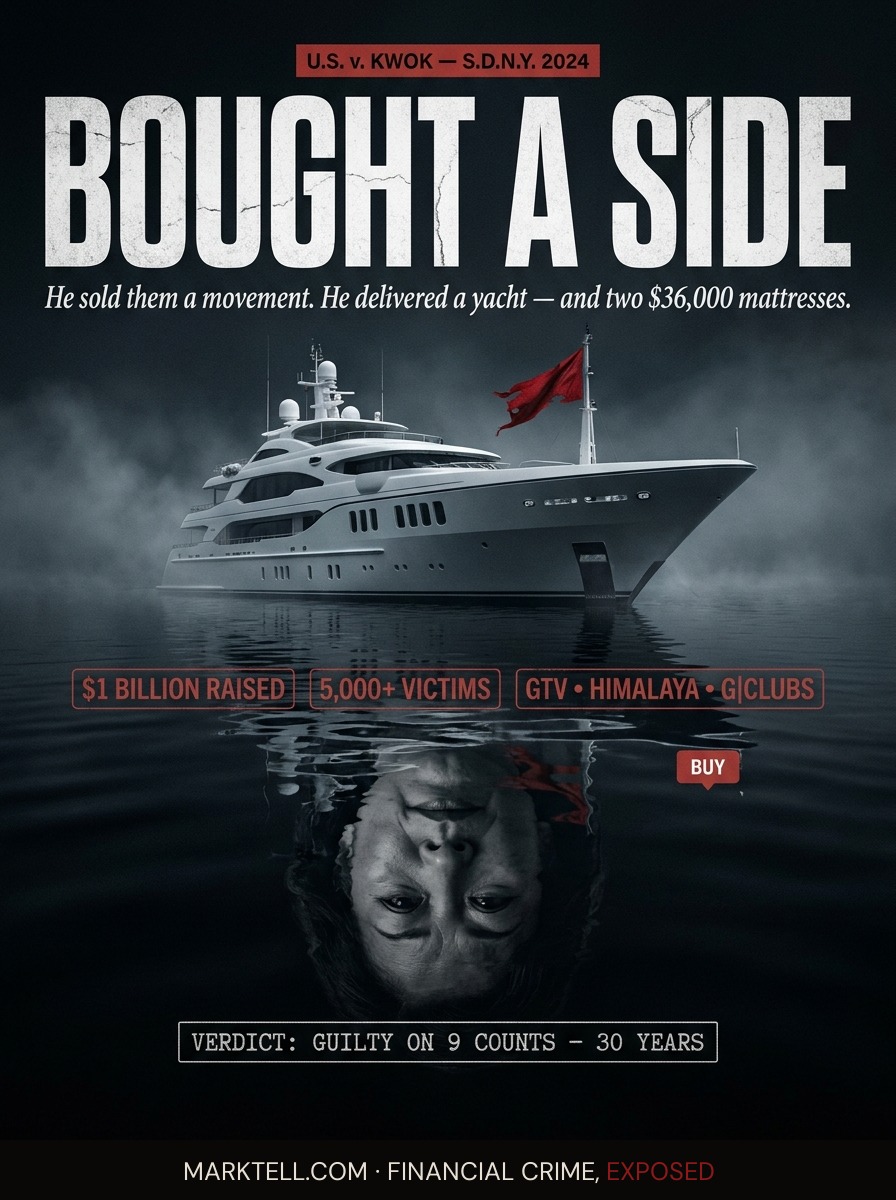
He sold them a movement. He bought a yacht and two mattresses.
A self-exiled Chinese billionaire built an anti-CCP movement online, took more than a billion dollars from the people who believed in it, and spent it on a yacht, a Ferrari, and a pair of $36,000 mattresses. On June 29, 2026, a Manhattan judge handed him thirty years.
Lin was fifty-eight the night she sent the wire. She managed the front of a restaurant on Main Street in Flushing, Queens, six days a week, and the seventh she spent on the phone with her sister in Wenzhou. She had been in the United States since she was twenty-six. Her English was good enough for the health inspector. Her Mandarin was still the language she dreamed in.
She watched Miles Guo on her phone during her dinner break. She propped it against the sugar jar in the back booth. He was loud and angry and rich and he said the things about the Communist Party that her father had whispered in a kitchen in 1989. He said the West did not understand. He said the movement needed money. He said anyone who joined the movement would not only help the cause but would also be rewarded.
The night she wired the forty thousand dollars, she sat at her own kitchen table after the restaurant closed. The window over the sink was black. The offering page was open on her laptop. GTV Media Group. She remembers the green button. She remembers thinking she was not buying a stock. She was buying a side.
That, in the end, is what the case against Guo Wengui was about. He sold a side. He delivered a yacht.
I.
The court called him Ho Wan Kwok. His followers called him Miles. The Chinese government had been calling him a fugitive since 2017.
He arrived in the United States with a story already polished. He had been a real estate developer in mainland China. He had crossed the Party. He was a dissident now. He moved into a penthouse on Central Park South and started building an audience.
The audience was the asset. Hundreds of thousands of Chinese-speaking emigres in New York, in Los Angeles, in Vancouver, in London, watching his livestreams. He named a movement. He called it the New Federal State of China. He founded the Rule of Law Foundation and the Rule of Law Society in 2018. The names sounded like institutions. They functioned like funnels.
In 2018, Guo also began appearing on stages with Steve Bannon, the former Trump adviser. Bannon was eventually named in the federal case as an unindicted co-conspirator. He has not been charged in this matter.
What the followers saw was a man fighting the Communist Party. What the prosecutors later described was a man building an affinity-fraud machine. Affinity fraud is the name law enforcement gives to a scheme that runs on shared identity. The pitch lands because the pitcher looks like you, talks like you, prays like you, hates the same enemy. The trust comes free. The vetting never happens.
Lin did not vet. Her sister did not vet. Her cousin in Vancouver did not vet. None of them would have called it a stock pick. They would have called it loyalty.
II.
The first machine was GTV.
In April 2020, Guo and his network launched a stock offering for GTV Media Group, the company that hosted his livestreams. According to the SEC, roughly $452 million came in from more than five thousand investors. None of it was registered. None of the buyers had the disclosures the law requires.
There was also a parallel loan program. Another $150 million. The pitch was the same. Support the movement. Get paid.
In September 2021, the SEC settled with three Guo-linked entities, GTV Media Group, Saraca Media Group, and Voice of Guo Media Inc., for $539 million in refunds and penalties. The settlement did not stop the machine. It just made the next version of it use a different door.
The next door was crypto.
In 2021 and 2022, Guo's organization rolled out the Himalaya Exchange. It offered a token called Himalaya Coin, ticker HCN, and a purported stablecoin called the Himalaya Dollar. Investors were told that 20 percent of the value behind these instruments was backed by gold. Prosecutors would later say there was no such gold. The exchange pulled in approximately $262 million.
The third door was a membership club. G|CLUBS, marketed as an exclusive lifestyle and information service, took in roughly $250 million more.
Read those numbers slowly.
$452 million. $150 million. $262 million. $250 million.
Over a billion dollars, raised from people who thought they were funding a country in exile.
III.
Lin found out the way most of them found out. Slowly, then all at once.
The HCN balance in her Himalaya app stopped moving the way the livestreams said it would. She asked her cousin. Her cousin asked the chat group. The chat group told her to be patient. The movement was being attacked. The CCP was behind the rumors. The price would come back.
Then, in March 2023, the FBI arrested Guo at his apartment on Central Park South. The same week, agents boarded a 145-foot yacht called the Lady May. The boat had been bought, the indictment said, with investor money. It cost $37 million.
The indictment is where you learn what the money actually did.
A $26.5 million mansion in New Jersey. A $3.5 million Ferrari. A $1 million Lamborghini. A $37 million yacht. Two mattresses, the indictment specified, at $36,000 each.
Picture that. Two mattresses. Seventy-two thousand dollars to sleep on.
Lin's wire had been forty thousand. She worked twelve-hour shifts. The mattresses were worth almost two of her.
Between September 2022 and March 2023, U.S. authorities seized roughly $634 million in fraud proceeds from twenty-one bank accounts. That number is from the DOJ. It is the recovery side of the ledger. It is what was found before it could be moved again.
IV.
The trial in Manhattan ran seven weeks. On July 16, 2024, a federal jury convicted Guo Wengui on nine of twelve counts, including racketeering conspiracy, wire fraud, securities fraud, and money laundering.
His chief of staff, Yvette Wang, had already pleaded guilty. On January 6, 2025, she was sentenced to ten years in prison and agreed to forfeit $1.4 billion. His financier, Kin Ming Je, also charged, remains at large.
In April 2026, prosecutors filed their sentencing memorandum. They asked for at least thirty years. They wrote that Guo's crimes were "among this nation's worst and most rampant frauds" and that they had "destroyed hundreds of lives."
On Monday, June 29, 2026, Judge Analisa Torres gave them the number they asked for.
Thirty years.
Guo is in his late fifties. The math is not subtle.
V.
Lin still has the laptop. She does not open it.
She told her sister, finally, last winter. She did not tell her son. She is not sure she ever will. The shame is not about the money. She has worked too long to be ashamed of losing money. The shame is about what she was buying. She thought she was buying a side. She thought she was a soldier in a quiet war. She was a customer in a quiet store.
That is the part that does not appear in the indictment. That is the part that does not get a dollar figure.
Affinity fraud is rarely about products. It is about the moment a person decides that this voice, this stage, this flag, is finally the one that sees them. Guo Wengui found hundreds of thousands of those moments. He converted them into a yacht.
The machine he built is not unusual. The flag was unusual. The funnel was not. There is a version of this machine running right now in a Mandarin-language Telegram group, and a Spanish-language WhatsApp group, and an Amharic-language YouTube channel, and a Punjabi-language livestream. The pitch is always the same. We are the ones who tell the truth. The others are lying to you. Send money. Be a part of it.
Lin watched Guo on her phone for two years before she sent the wire. She thought she was deciding. She was being closed.
The thirty years are for him. The mattresses are evidence. The movement was the pitch.
She bought a stock. She thought she bought a country.
- U.S. Department of Justice, Southern District of New York | June 29, 2026 | Sentencing announcement, United States v. Ho Wan Kwok
- U.S. Department of Justice, SDNY | July 16, 2024 | Jury verdict, United States v. Ho Wan Kwok
- U.S. Securities and Exchange Commission | September 13, 2021 | Settlement with GTV Media Group, Saraca Media Group, Voice of Guo Media Inc.
- U.S. Department of Justice, SDNY | March 15, 2023 | Indictment and arrest of Guo Wengui; seizure of Lady May yacht
- U.S. Department of Justice, SDNY | January 6, 2025 | Sentencing of Yvette Wang
- U.S. Department of Justice, SDNY | April 24, 2026 | Government's sentencing submission
- Boston Herald / Associated Press | June 29, 2026 | Coverage of Guo Wengui sentencing
Editorial Notice
MarkTell is a true crime publication about financial fraud. Some scenes, dialogue, and sequential details are reconstructed from court filings, enforcement actions, news reports, and public records. Where the public record does not provide exact details, editorial reconstruction is used to convey the documented pattern of events. Names of private individuals may be changed to protect identity. All factual claims are sourced to public documents cited in the Evidence Trail above. MarkTell does not provide investment, legal, or financial advice. Nothing published here constitutes a recommendation to buy, sell, or avoid any investment. Allegations described in active cases have not been adjudicated and defendants are presumed innocent until proven guilty. Readers should conduct their own due diligence before making financial decisions.